

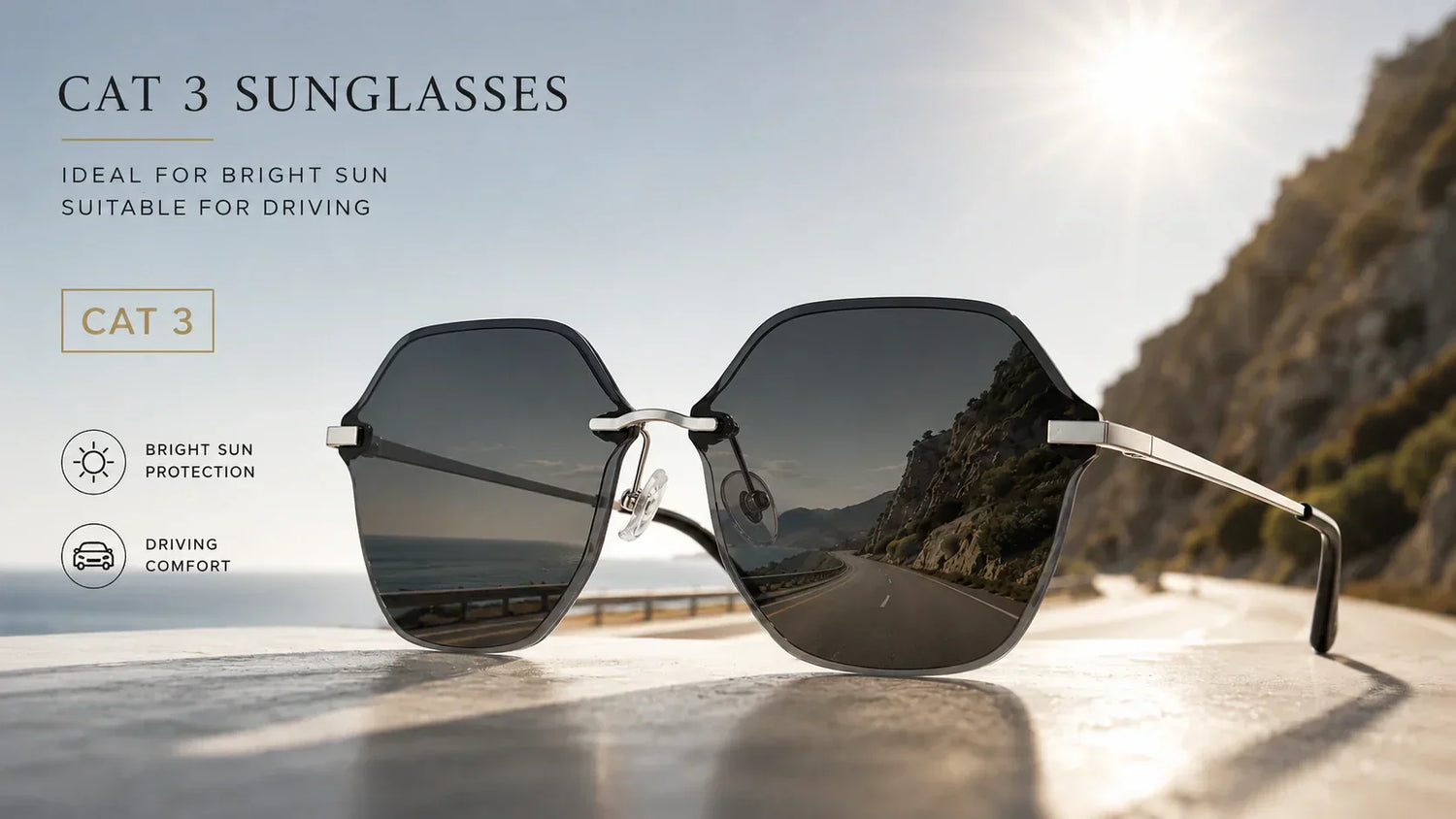
Category 3 sunglasses are dark visible-light lenses designed for bright daytime conditions. Category 3, often shortened to Cat 3, usually means approximately 8–18% visible light transmission. It does not automatically mean UV400, and it does not automatically mean polarized.
Use Cat 3 as one part of the decision: confirm UV400 protection, decide whether reflected glare requires polarization, then choose lens color and frame fit for the way you wear the sunglasses.

What Does Category 3 Mean?
Lens categories describe how much visible light passes through a sunglass lens. A lower VLT percentage means a darker lens. Category 3 is commonly used for bright sun, beach light, open roads and strong outdoor daylight.
| Term | What it tells you | What it does not prove |
|---|---|---|
| Category 3 / Cat 3 | Visible-light darkness for bright conditions | UV400, polarization or lens material |
| VLT | The percentage of visible light transmitted | Ultraviolet protection by itself |
| UV400 | Ultraviolet protection up to 400 nanometers | How dark the lens feels |
| Polarized | Reduction of reflected glare | Lens darkness or UV400 by itself |
Lens Categories at a Glance
| Category | General tint level | Typical use | Driving note |
|---|---|---|---|
| Cat 0 | Very light or clear | Fashion or low-light use | Not for strong sun |
| Cat 1 | Light tint | Cloudy or low-brightness conditions | Limited bright-sun comfort |
| Cat 2 | Medium tint | Mixed daylight and city use | Can feel easier in changing light |
| Cat 3 | Dark tint | Bright sun, beach, travel and open roads | Daytime only; check local rules and visibility |
| Cat 4 | Very dark tint | Extreme glare and specialist environments | Generally unsuitable for driving |
Cat 2 vs Cat 3 Sunglasses
Cat 2 lenses are lighter and often more comfortable in mixed daylight, cloudy weather and frequent indoor-outdoor transitions. Cat 3 lenses reduce more visible brightness and usually feel better in strong sun.
A darker lens is not always better. Choose Cat 3 when strong overall brightness is the problem. Choose Cat 2 or a gradient route when conditions change frequently or when a very dark lens makes the face and lower view feel too covered.
Category 3 vs UV400
Category 3 and UV400 answer different questions. Category 3 describes visible-light darkness. UV400 describes ultraviolet protection.
A dark Cat 3 lens should still clearly state UV400 or 100% UVA/UVB protection. Do not assume that a dark-looking lens provides adequate UV protection.
Category 3 vs Polarized
Category 3 reduces overall visible brightness. Polarization targets reflected glare from roads, water, wet pavement, snow and glass. A lens can be both Cat 3 and polarized, but either feature must be confirmed separately.
| Your problem | Look for |
|---|---|
| Strong overall sunlight | Suitable tint category plus UV400 |
| Road, water or wet-surface reflections | Polarization plus UV400 |
| Phone, GPS, dashboard or HUD readability | Test the display through the actual lens |
| Softer daily appearance | Cat 2, gradient or lighter tint route |
For the protection and glare distinction, read UV400 vs polarized sunglasses.
Are Category 3 Sunglasses Good for Driving?
Category 3 sunglasses can be useful for bright daytime driving, provided the tint does not make shaded roads, tunnels, traffic signals, mirrors, dashboards or navigation difficult to see. They are not suitable for night driving.
If wet roads or windshield reflections are the main problem, polarization may matter more than choosing the darkest lens. Some polarized lenses can affect screen visibility, so test the pair in your own vehicle before relying on it.
When Cat 3 May Feel Too Dark
- Cloudy city days
- Shaded streets
- Tunnels
- Late afternoon
- Frequent indoor-outdoor transitions
- Any situation where signs or displays become difficult to read
In changing light, compare a lighter, gradient or photochromic route rather than assuming maximum darkness is best.
Does Lens Color Change the Decision?
Category 3 describes darkness, not color. Gray, brown, green-gray, rose and gradient lenses can all create different visual results even when their light transmission is similar.
| Lens color | Typical result |
|---|---|
| Gray or smoke | Neutral color balance in bright daylight |
| Brown or bronze | Warmer contrast and softer outdoor color |
| Green-gray | Balanced contrast with a less black appearance |
| Rose | Warmer visual mood and softer face result |
| Gradient | Darker overhead protection with a lighter lower view |
For a fuller comparison, use the sunglass lens color guide.
Choose by Use Case
| Main use | Best next route |
|---|---|
| Bright daytime driving and travel | Compare Driving & Travel sunglasses |
| Softer tint and greater face visibility | Compare Rimless Gradient sunglasses |
| Changing light | Compare photochromic and polarized lenses |
FAQ
What does Category 3 mean in sunglasses?
It describes a dark visible-light filter commonly used for bright daytime conditions, usually around 8–18% VLT.
Does Category 3 mean UV400?
No. Confirm UV400 or 100% UVA/UVB protection separately.
Does Category 3 mean polarized?
No. Polarization is a separate glare-reduction feature.
What is the difference between Cat 2 and Cat 3?
Cat 2 is lighter and often better for mixed daylight. Cat 3 is darker and generally better for strong sun.
Are Category 3 sunglasses suitable for driving?
They can be suitable for bright daytime driving where permitted, but not for night driving. Check shaded-road, tunnel, dashboard and screen visibility.
Should I choose Cat 3 or polarized sunglasses?
Choose Cat 3-style darkness for strong overall brightness. Choose polarization for reflected glare. Many bright outdoor situations benefit from both plus UV400 protection.