
Quick answer: photochromic sunglasses change tint as light changes, while polarized sunglasses reduce reflected glare. If you drive often, glare control is usually the first priority because road glare, wet pavement, windshield reflection, and low sun can be more distracting than brightness alone. Photochromic lenses can help in changing outdoor light, but not every photochromic lens darkens strongly behind a car windshield.
The important point is that these lens names do not compete on one single scale. Photochromic lenses solve changing light. Polarized lenses solve reflected glare. Gradient lenses create softer brightness control and a lighter face effect. If you want both tint change and glare reduction, look for sunglasses that clearly list both photochromic and polarized lens features.
This guide compares the three lens behaviors as a decision system, not as a general eyewear encyclopedia. For UV protection basics, start with our UV400 vs polarized sunglasses guide. For a practical polarization check, read how to tell if sunglasses are polarized.
If your harder question is how bronze, gray, green, rose, or gradient tints change outdoor clarity, read the outdoor blue light and lens color guide. It explains how tint color affects haze, contrast, glare comfort, and face visibility before you choose a lens route.

Quick Answer: Polarized vs Photochromic vs Gradient
| Lens Type | Best For | Main Benefit | Main Limitation |
|---|---|---|---|
| Polarized sunglasses | Water, road glare, wet pavement, snow, glass reflections | Reduces reflected glare so bright surfaces feel calmer | Can make some phone, dashboard, HUD, or LCD screens harder to read |
| Photochromic sunglasses | Changing light, indoor-outdoor movement, variable weather | Tint adjusts automatically when light conditions change | May not darken as expected behind some car windshields |
| Photochromic + polarized sunglasses | Users who want both changing-light comfort and glare reduction | Can combine tint change with reflected-glare control when both features are listed | You must verify both features in the product specs; one label does not prove the other |
| Gradient sunglasses | Driving, reading outdoors, cafe wear, city wear, softer face visibility | Darker at the top, lighter at the bottom for a more open lower view | Does not reduce reflected glare by itself unless also polarized |
What Is the Difference Between Photochromic and Polarized Sunglasses?
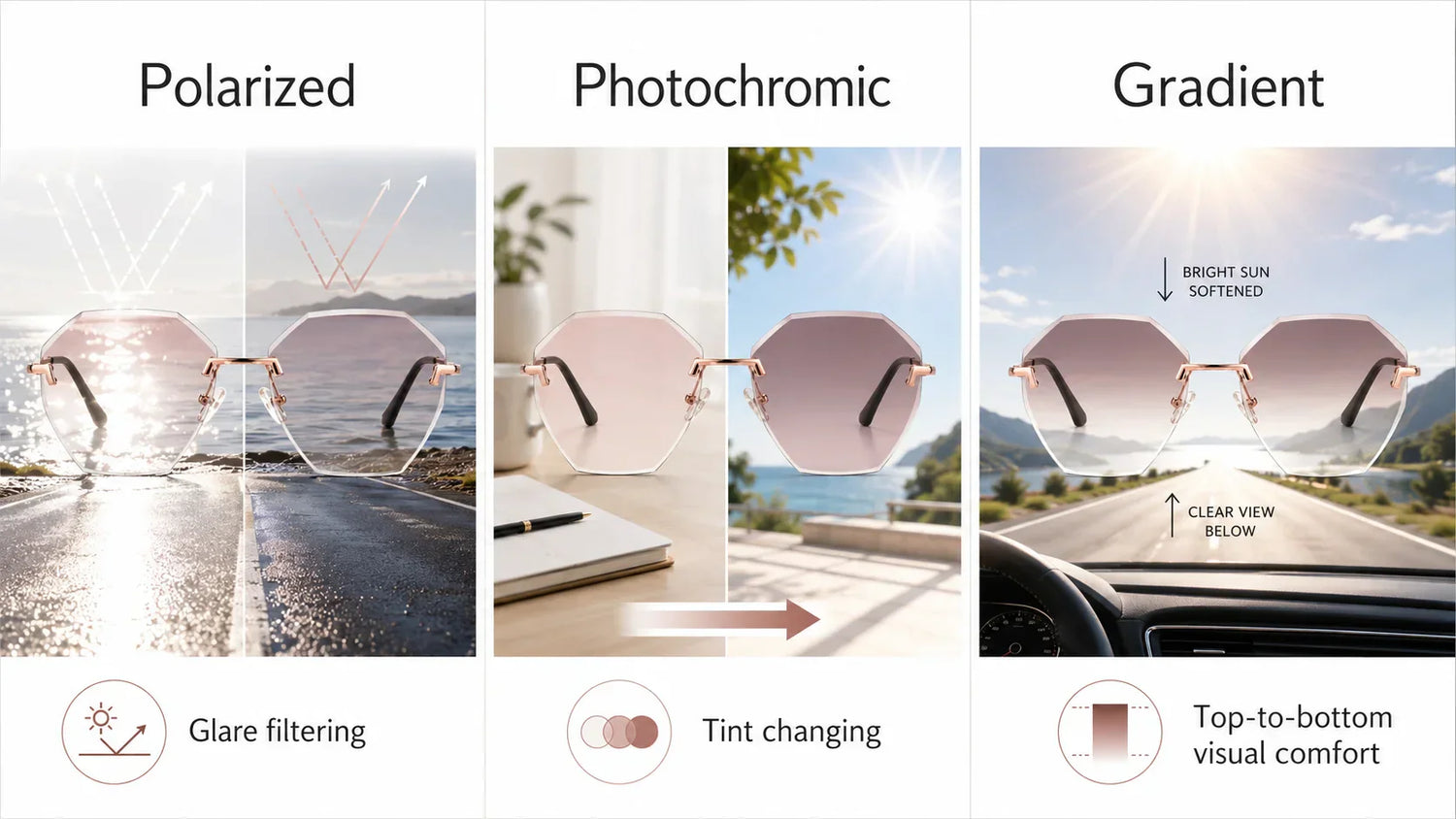
The difference is simple: photochromic describes tint change, while polarized describes glare filtering.
A photochromic lens changes its tint as light conditions change. In brighter outdoor light, it becomes darker. In lower light or indoor conditions, it becomes lighter again. This is useful when you do not want to switch between clear glasses and sunglasses throughout the day.
A polarized lens uses a filter that reduces certain reflected light from flat surfaces. That is why polarized sunglasses are especially useful around water, wet roads, snow, glass, and strong road glare. They do not automatically change from clear to dark. They solve glare, not changing-light convenience.
Use this rule: if your complaint is glare, think polarized. If your complaint is light changes all day, think photochromic. If your complaint is visual heaviness on the face, think gradient.
Are Photochromic Lenses Polarized?
Not always. Photochromic and polarized are separate lens features. A lens can be photochromic but not polarized, polarized but not photochromic, both, or neither.
| Lens Label | What It Means | What to Check |
|---|---|---|
| Photochromic | The tint changes with light exposure | How dark it gets outdoors and how fast it clears indoors |
| Polarized | The lens reduces reflected glare | Whether it affects screens and how well it handles water or road glare |
| Photochromic + polarized | The lens changes tint and reduces reflected glare | Whether both features are listed in the product details |
| Gradient | The tint fades from darker top to lighter bottom | Whether it is also UV400 or polarized if you need protection or glare control |
If a product page only says photochromic, do not assume it is polarized. If it only says polarized, do not assume it changes tint. Look for both terms in the product details if you want both behaviors.



Are Photochromic Sunglasses Good for Driving?
Photochromic sunglasses can be useful for changing outdoor light, but they are not automatically the best driving lens. Many photochromic lenses respond mainly to UV light, and a car windshield can reduce the UV that reaches the lens. That means some photochromic lenses may stay lighter inside the car than they do outdoors.
For driving, the first question is usually glare. If road glare, wet pavement, windshield reflection, or low sun is your main problem, polarized sunglasses are often the stronger starting point. If you also want automatic tint adjustment, look for sunglasses that clearly list both photochromic and polarized features.
Which Lens Is Better for Driving?
For driving, the best lens depends on the exact problem. Do not choose only by lens darkness or by the lens name alone. Choose by glare control, dashboard readability, HUD compatibility, lens category, and whether the frame gives you a clean peripheral view.

| Driving Situation | Better Lens Choice | Why |
|---|---|---|
| Wet road glare or low-angle sun reflection | Polarized | Glare is the main problem |
| Bright overhead sun plus dashboard visibility | Gradient | Darker upper tint helps with sun while the lower area stays easier to see through |
| Moving between car, store, office, and outdoors | Photochromic | Changing tint can be convenient across different environments |
| Long highway daylight driving | Polarized or gradient | Choose polarized for glare, gradient for a more open lower view |
| Night driving | Avoid dark sunglasses | Dark lenses can reduce visibility in low light |
For driving-focused comparison, also read our best sunglasses for driving guide.
When Photochromic Sunglasses May Disappoint You
Photochromic sunglasses are useful when your day moves between shade, indoor spaces, cloudy light, and bright outdoor sun. But they can disappoint if you buy them mainly because you expect them to turn very dark inside a car.
Many standard photochromic lenses react to ultraviolet light, and some car windshields reduce the UV exposure that activates the lens. That means the lens may not darken as strongly behind the windshield as it does outdoors. If your main problem is road glare, wet pavement, water reflection, or low-angle sun, a polarized or glare-reducing driving lens may be the better first choice.
The safer buying logic is: choose photochromic for changing light; choose polarized for reflected glare; choose gradient when you want softer upper brightness with better lower-view readability.
When Polarized Sunglasses May Not Be Ideal
Polarized sunglasses are strong for reflected glare, but they are not automatically perfect for every driver or every device. Some polarized lenses can make phone screens, digital dashboards, LCD panels, or head-up displays look darker or uneven at certain angles.
This does not make polarized sunglasses bad. It means you should test them with your own phone, dashboard, and car display before using them as your only driving pair. For more screen-specific detail, read do polarized sunglasses work with touchscreens.

Which Lens Is Better for Water, Beach, or Snow?
For water, beach, boating, fishing, and snow glare, polarized lenses usually have the clearest advantage because reflected light is the main issue. A regular dark lens can reduce brightness, but it may not remove glare from the surface of water or wet sand.
Photochromic lenses can help when the day moves between shade, clouds, and bright sun. But if glare from water is the reason you are uncomfortable, photochromic tint alone is not the same as polarization.
Gradient lenses can feel stylish and open on the face, but gradient tint alone should not be treated as a water-glare solution. For water sports and boating, choose polarization first, then consider tint color, coverage, and frame security.
If the same outdoor day includes trail walking, lake paths, national park travel, or bright open overlooks, use our best hiking sunglasses for women guide to compare UV400 protection, glare control, lightweight fit, and photo-ready gradient lenses together.
Where Gradient Sunglasses Make Sense
Gradient sunglasses are often misunderstood. They are not just a fashion feature, but they are also not the same kind of technology as polarization or photochromic tint change. The darker top area helps with overhead sunlight, while the lighter lower area keeps the bottom of your view more open. That makes gradient lenses useful for daily wear, outdoor reading, driving, cafe seating, and city walking.
Gradient lenses also work well when you want sunglasses that do not fully hide the face. For BAPORSSA styling, this matters: a lighter lower tint can keep the eye area softer, cleaner, and more visible than a fully dark lens. That is why gradient lenses pair well with rimless frames, makeup-friendly looks, and refined everyday outfits.
Choose gradient sunglasses if you want a softer face effect, dashboard visibility, book or phone visibility, or a more dressed-up city look. Choose polarized instead if your main issue is harsh reflected glare.
Which Should You Choose?
| Your main problem | Better lens direction | BAPORSSA route |
|---|---|---|
| Changing light from shade to sun | Photochromic | Glow or photochromic styles |
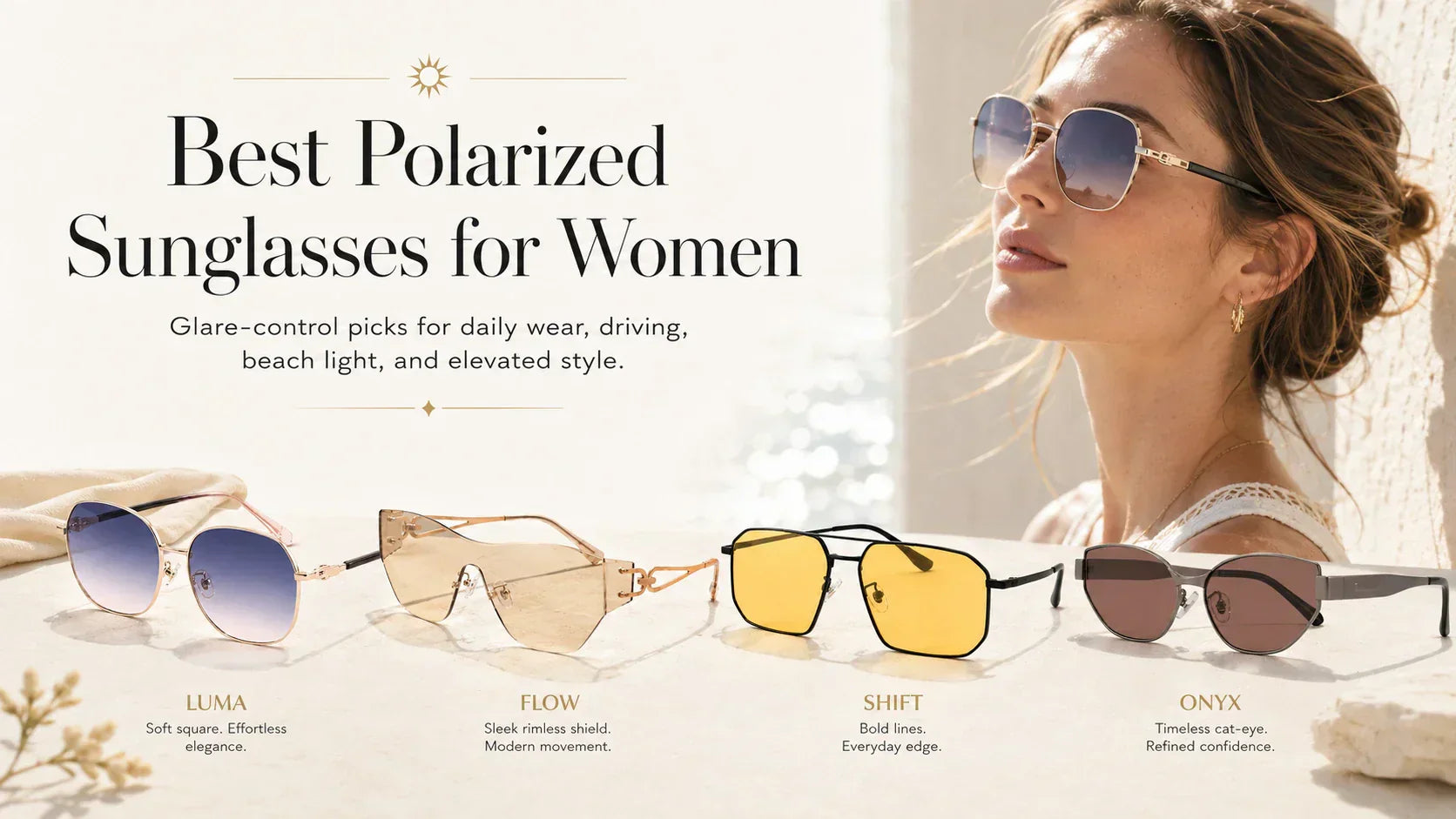
| Road glare, wet pavement, or windshield reflection | Polarized | Luma, Flow, or Driving & Travel |
| Bright outdoor travel and water reflection | Polarized with enough coverage | Flow |
| Daily wear with visible face and softer light | Gradient or lighter polarized route | Luma or Rimless Gradients |
| You want both tint change and glare reduction | Photochromic polarized, if both features are clearly listed | Check product specs before buying |
Common Mistakes When Choosing Lens Technology
1. Thinking dark lenses always protect better
Lens darkness and UV protection are not the same. A lens can look dark but still lack clear UV protection details. Always check for UV400 or 100% UVA/UVB protection before choosing by tint.
2. Thinking polarized means UV400
Polarization reduces glare. UV400 refers to ultraviolet protection. Many quality sunglasses include both, but one term does not automatically prove the other. Use the UV400 vs polarized guide if you need the full distinction.
3. Thinking photochromic always works perfectly in cars
Some photochromic lenses are not ideal behind windshields because the lens may receive less of the activating light it needs. For driving, compare real in-car performance, not just the word photochromic.
4. Thinking gradient lenses reduce glare like polarized lenses
Gradient tint changes vertically from darker to lighter. It does not automatically filter reflected glare. If you want both a gradient look and glare reduction, look for a lens that is described as both gradient and polarized.
5. Choosing lens color before choosing lens function
Color affects visual comfort, contrast, and style. Function decides whether the lens reduces glare, changes with light, or keeps part of your view lighter. Choose lens function first, then refine with color using our sunglasses lens color guide.
BAPORSSA Route: How to Choose Without Overthinking
Use this order:
- Start with UV protection. Check UV400 or 100% UVA/UVB protection first.
- Identify your light problem. Glare, changing light, and face visibility are different needs.
- Choose the lens behavior. Polarized for glare, photochromic for changing light, gradient for open lower vision and softer styling.
- Check your daily devices. If you rely on phone, dashboard, HUD, or work screens outdoors, test screen visibility before committing to a polarized pair.
- Match the frame to the lens. A heavy frame can ruin a good lens. For all-day wear, lens choice and fit should work together.
Check each product page for exact lens specifications. Polarization, photochromic behavior, tint depth, and colorway details can vary by model or color.
For deeper reading, continue with our polarized sunglasses guide. For screen issues, read why polarized sunglasses can make phone screens hard to see. For lens brightness categories, read our Cat 3 and VLT guide.

Final Recommendation
If you are choosing one pair, do not ask which lens is universally best. Ask which problem matters most in your daily light.
- Choose polarized if your main problem is reflected glare from roads, water, snow, or glass.
- Choose photochromic if your main problem is changing light between indoor, shade, and outdoor settings.
- Choose gradient if your main problem is harsh overhead sun, dashboard or reading visibility, and a softer face look.
- Choose photochromic + polarized only if the product clearly lists both features and the screen/vehicle behavior works for your routine.
The most practical BAPORSSA choice is not the most technical lens. It is the lens that matches your actual light problem, your face visibility preference, and your daily routine.
Shop Driving & Travel sunglasses if glare, road light, water reflection, or changing sunlight is your main concern. Explore Rimless Gradient sunglasses if you want softer face visibility and lighter daily wear.
Related Guides
| If you want to understand | Read this next |
|---|---|
| Driving glare and lens color | Best sunglasses for driving |
| How to check if lenses are polarized | How to tell if sunglasses are polarized |
| UV400 vs glare control | UV400 vs polarized sunglasses |
| Lens darkness and Cat 3 | Cat 3 sunglasses and VLT guide |
| Daily tint and face visibility | Rimless gradient sunglasses |
FAQ
What is the difference between polarized and photochromic lenses?
Polarized lenses reduce reflected glare from flat surfaces such as roads, water, snow, and glass. Photochromic lenses change tint when light conditions change. They solve different problems.
Are photochromic lenses polarized?
Not always. Photochromic lenses change tint in response to light, while polarized lenses reduce reflected glare. A lens can be photochromic, polarized, both, or neither.
Which is better, photochromic or polarized sunglasses?
Polarized sunglasses are better for reflected glare from roads, water, snow, and glass. Photochromic sunglasses are better for changing light conditions where you move between indoors, shade, and outdoors.
Are photochromic sunglasses good for driving?
They can be useful in changing outdoor light, but they are not automatically the best driving lens. Some photochromic lenses may not darken strongly behind a windshield. If road glare is your main issue, polarized sunglasses are usually the stronger starting point.
Can photochromic sunglasses be used for driving?
Some can, but standard photochromic lenses may not darken as strongly behind certain car windshields. If driving is your main use, check whether the lens is designed for in-car activation and compare it with polarized or gradient driving options.
Which is better for glare, photochromic or polarized?
Polarized is the better starting point for reflected glare. Photochromic tint can reduce brightness as it darkens, but it does not automatically filter reflected glare unless the lens is also polarized.
Can sunglasses be photochromic and polarized at the same time?
Yes, but only if both features are built into the lens. Look for product details that clearly mention both photochromic tint change and polarization.
Are gradient sunglasses polarized?
Not necessarily. Gradient describes a tint that is darker at the top and lighter at the bottom. Polarized describes glare filtering. A gradient lens can be polarized, but it is not automatically polarized.
Are gradient lenses good for driving?
Gradient lenses can be useful for driving because the darker upper area helps with overhead sunlight while the lighter lower area can make the dashboard and lower field of view easier to see.
Do polarized sunglasses work with phone screens?
They can make some digital screens look darker, rainbow-like, or harder to read at certain angles. If screen visibility matters, test the sunglasses with your phone before choosing a polarized pair.