
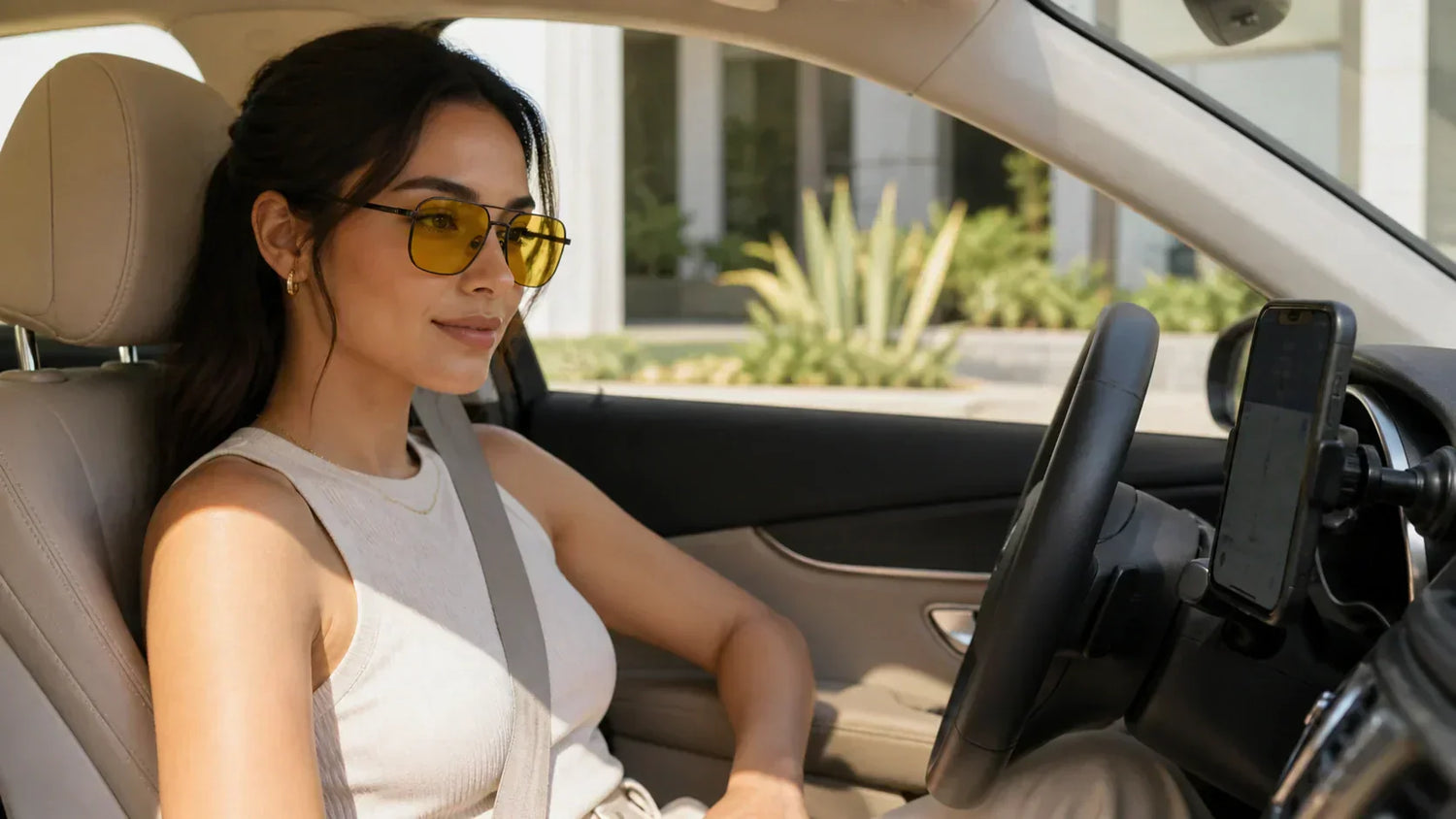
Quick answer: If your phone screen looks black, dark, patchy, or rainbow-like through polarized sunglasses, your phone is probably not broken and the sunglasses are probably not defective. Polarized lenses filter light direction, and many phone, dashboard, GPS, ATM, camera, and HUD screens also use polarized light. Rotate the phone, tilt the screen, raise brightness, or use a screen-comfort lens route when displays matter more than glare control.
The real decision is simple: choose polarized sunglasses when reflected glare is the main problem; choose by screen comfort when phones, dashboards, GPS, and displays are part of your daily routine. For the full lens framework, read our UV400 vs polarized sunglasses guide.

First: Is This Normal?
Yes. This is a normal optical effect with many polarized sunglasses and digital displays. Polarized lenses are designed to reduce reflected glare, but some screens emit light in a direction that conflicts with the lens filter. That is why the screen can look dim, patchy, rainbow-like, or black at certain angles.
If touch still works and the screen looks normal without the sunglasses, the issue is visibility through the lens, not touchscreen failure.
Is It the Touchscreen or the Lens?
Touch usually still works. The screen may look unreadable through the lens, but your finger can still tap it. If the display looks normal after you remove the sunglasses, the issue is the lens-screen angle, not the phone.
Quick Fix: What to Do When the Screen Looks Black
| Fix | What to do | Why it helps |
|---|---|---|
| Rotate the phone 90° | Try portrait and landscape orientation. | Changing the angle can change how the screen light meets the polarized lens. |
| Tilt the screen slightly | Move the phone or display a few degrees. | A small viewing-angle change can reduce the dark-screen effect. |
| Raise brightness | Use higher brightness outdoors. | It does not remove the optical conflict, but it can make the display easier to read. |
| Use light mode or high contrast | Switch navigation and maps to brighter display settings. | Light backgrounds and contrast can be easier to read through tinted lenses. |
| Test car displays before driving | Check dashboard, GPS, rear camera, and HUD from your normal driving position. | Car display behavior varies by screen type, angle, and lens orientation. |
Why Polarized Sunglasses Make Screens Dark

Polarized lenses reduce reflected glare by filtering light direction. Many digital screens also emit polarized light. When the screen direction and sunglass filter direction cross each other, part of the display can look dim, striped, rainbow-like, or almost black.
This can happen with phones, tablets, laptops, car dashboards, GPS screens, camera displays, ATMs, fuel pumps, and some head-up displays. The exact effect depends on screen type, screen brightness, screen protector, viewing angle, and lens angle.
Which Screens Are Most Affected?
| Screen type | What you may notice | Best first check |
|---|---|---|
| Phone screen | Dark, black, patchy, or rainbow-like areas | Rotate the phone or tilt it slightly. |
| Car dashboard / GPS | Dim numbers, uneven display, or poor navigation visibility | Test from your normal driving position before relying on one pair. |
| HUD / head-up display | Faint or disappearing projected information | Check the HUD in real daylight before driving. |
| Camera screen | Hard-to-read preview or exposure screen | Tilt the camera display or remove the sunglasses for critical checks. |
| ATM / fuel pump | Black or uneven display at certain angles | Change viewing angle or briefly lift the sunglasses. |
Important for Driving: Test Your Dashboard and HUD First
Polarized sunglasses can reduce daytime road glare, wet-road glare, and reflected light from flat surfaces. But they can also make some dashboards, GPS screens, rear-camera displays, or head-up displays harder to read.
Before using one pair as your main driving sunglasses, test the dashboard, navigation screen, rear-camera screen, and HUD from your normal driving position. If the display becomes too dark or uneven, choose a different lens route for that car or keep another pair available.
Should You Keep Polarized Sunglasses or Switch?
| Your situation | Better route | Why |
|---|---|---|
| Phone screen turns black often | Screen-comfort daily route | Choose by screen visibility, tint softness, and daily comfort first. |
| Dashboard, GPS, or HUD is hard to read | Test before choosing driving sunglasses | Display behavior varies by car, screen type, and viewing angle. |
| You mainly fight road, water, snow, or wet-pavement glare | Polarized glare-control route | Polarization is designed for reflected glare. |
| You use phone, camera, GPS, or tablet all day | Lighter daily lens route | Screen convenience may matter more than maximum glare control. |
| You want one everyday pair | Choose by screen use first, glare second | Most users notice screen inconvenience more often than extreme glare. |
Choose by What Bothers You More
The right answer is not “polarized is always better” or “avoid polarized completely.” Choose by your main problem.
| If your main problem is... | Start with... | CTA |
|---|---|---|
| Phone, camera, GPS, and screen visibility | Screen-comfort daily route | Explore lighter daily styles |
| Road glare and driving brightness | Driving / travel route | Explore driving styles |
| Water, snow, wet roads, or strong reflected glare | Polarized / strong-glare route | View Flow |
| You are unsure whether polarization is worth the tradeoff | Decision guide | Read Are Polarized Sunglasses Always Better? |
Polarized vs Non-Polarized for Phone Use

| Lens route | Best for | Screen tradeoff |
|---|---|---|
| Polarized sunglasses | Road glare, water, snow, wet pavement, and reflections | Can make some screens darker, patchy, or uneven. |
| Non-polarized UV400 sunglasses | Phone use, camera screens, daily city wear, dashboards | Does not cut reflected glare as strongly. |
| Gradient or lighter daily lenses | Commuting, style, shade transitions, face visibility | May feel easier for screens, but always check exact lens specs. |
If you are still deciding whether polarization is worth it, read Polarized vs non-polarized sunglasses: worth it, drawbacks, and headaches.
When Polarized Sunglasses Are Still the Better Choice
If your main issue is road glare, water glare, snow glare, wet pavement, or bright reflected light—not screen visibility—then polarized styles may still be the better route.
If glare is still your main issue, compare the BAPORSSA driving and travel collection, or start with Flow for stronger bright-light coverage and Shift for driving and changing daylight.
For more driving-specific details, continue with our best sunglasses for driving guide.
Related Lens & Light Guides
- UV400 vs Polarized vs Non-Polarized Sunglasses
- Polarized vs Non-Polarized Sunglasses
- How to Tell If Sunglasses Are Polarized
- Sunglasses Lens Color Guide
- Photochromic vs Polarized Sunglasses
FAQ
Why can’t I see my phone with polarized sunglasses?
Many screens emit polarized light. When that light crosses the filter in polarized sunglasses, the phone screen can look dark, patchy, rainbow-like, or black at certain angles.
Do polarized sunglasses stop touchscreens from working?
No. Touch usually still works. The issue is screen visibility, not touch function.
Why do polarized sunglasses make screens black?
The screen and lens can filter light in conflicting directions. When the angles cross, less display light reaches your eyes, so the screen can look black or very dim.
How do I fix a black phone screen with polarized sunglasses?
Rotate the phone 90 degrees, tilt the screen slightly, raise brightness, use light mode or high contrast, or choose a different lens route for screen-heavy days.
Why does my phone screen turn black when I rotate it?
Screen visibility changes when the phone angle changes because the screen light and polarized lens filter meet at a different angle. Try both portrait and landscape orientation to see which is clearer.
Are polarized sunglasses bad for phone use?
Not bad, but sometimes inconvenient. Polarized sunglasses are useful for reflected glare, but screen-heavy users may prefer a lighter daily lens route when phones, cameras, GPS screens, or dashboards matter more.
Should I buy polarized sunglasses if I use GPS while driving?
Test your car first. Polarized sunglasses can help with road glare, but some GPS screens, dashboards, rear-camera displays, and HUDs may look darker through polarized lenses.
Are non-polarized sunglasses better for phone use?
Often yes. Non-polarized UV400 sunglasses are usually easier for phones, dashboards, ATMs, GPS screens, and camera screens, but they do not reduce reflected glare as strongly as polarized lenses.
Can polarized sunglasses make a car dashboard hard to read?
Yes. Some dashboard screens, navigation displays, and HUDs can appear darker or uneven through polarized lenses. Test your own car before relying on one pair for driving.
Are polarized sunglasses better for driving?
They can help with bright daytime road glare and wet pavement reflections. However, test dashboard and HUD visibility first because some displays can look darker through polarized lenses.