
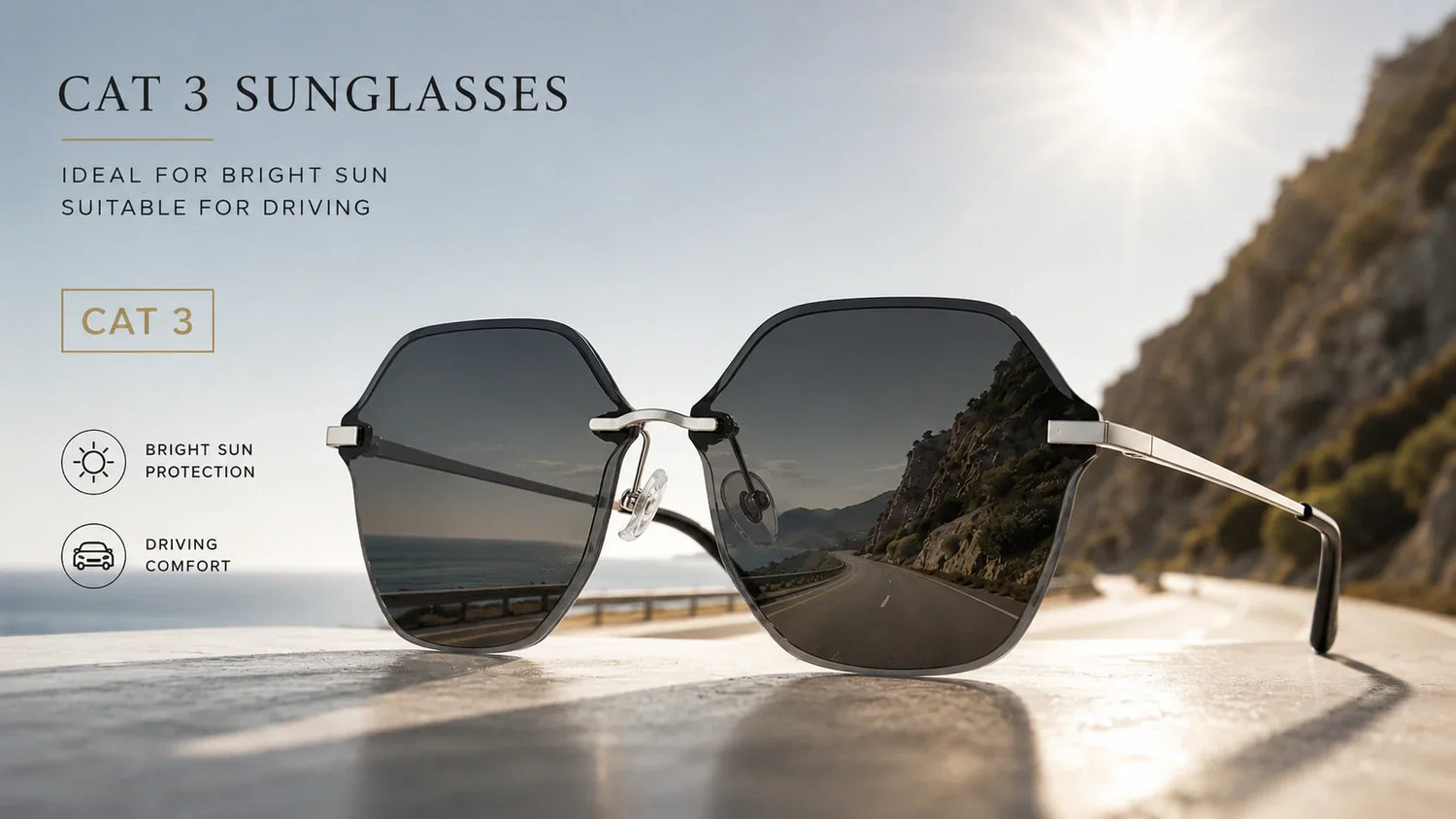
Quick answer: Cat 3 sunglasses are dark bright-sun lenses, usually around 8–18% visible light transmission or VLT. They are commonly used for strong daylight, beach light, open roads, travel, and daytime driving where local rules allow. Cat 3 tells you how dark the lens is, but it does not automatically prove UV400 protection or polarization.
If you are asking what does Cat 3 mean on sunglasses, use this buying rule: Cat 3 helps with brightness. UV400 helps with UV protection. Polarization helps with reflected glare. The best Cat 3 sunglasses for daily use should make all three points clear.
BAPORSSA route: For bright daylight, start with sunglasses that combine a bright-sun lens feel with UV400 protection, polarized glare control, and a frame you can wear for hours. If road glare, beach glare, or travel sun is the real problem, compare Shift, Luma, and Flow first.
| Term | Simple meaning | Important difference |
|---|---|---|
| Cat 3 | Dark lens category for bright daylight | Not the same as UV protection |
| VLT | How much visible light passes through the lens | Cat 3 is usually around 8–18% VLT |
| UV400 | Blocks UVA and UVB rays up to 400nm | A lens can be UV400 without being Cat 3 |
| Polarized | Reduces reflected glare from roads, water, and glass | Not the same as lens darkness or UV rating |
| If you want... | Best Cat 3 sunglasses route | Start here |
|---|---|---|
| Bright-sun daily wear | Cat 3-style darkness + UV400 | Shift |
| Road, beach, or water glare | Cat 3-style darkness + polarized glare control | Luma |
| More coverage in strong daylight | Wider bright-day lens coverage with clear UV protection | Flow |
| Driving use | Brightness control that still feels clear in shade and dashboard viewing | Shift / Luma |
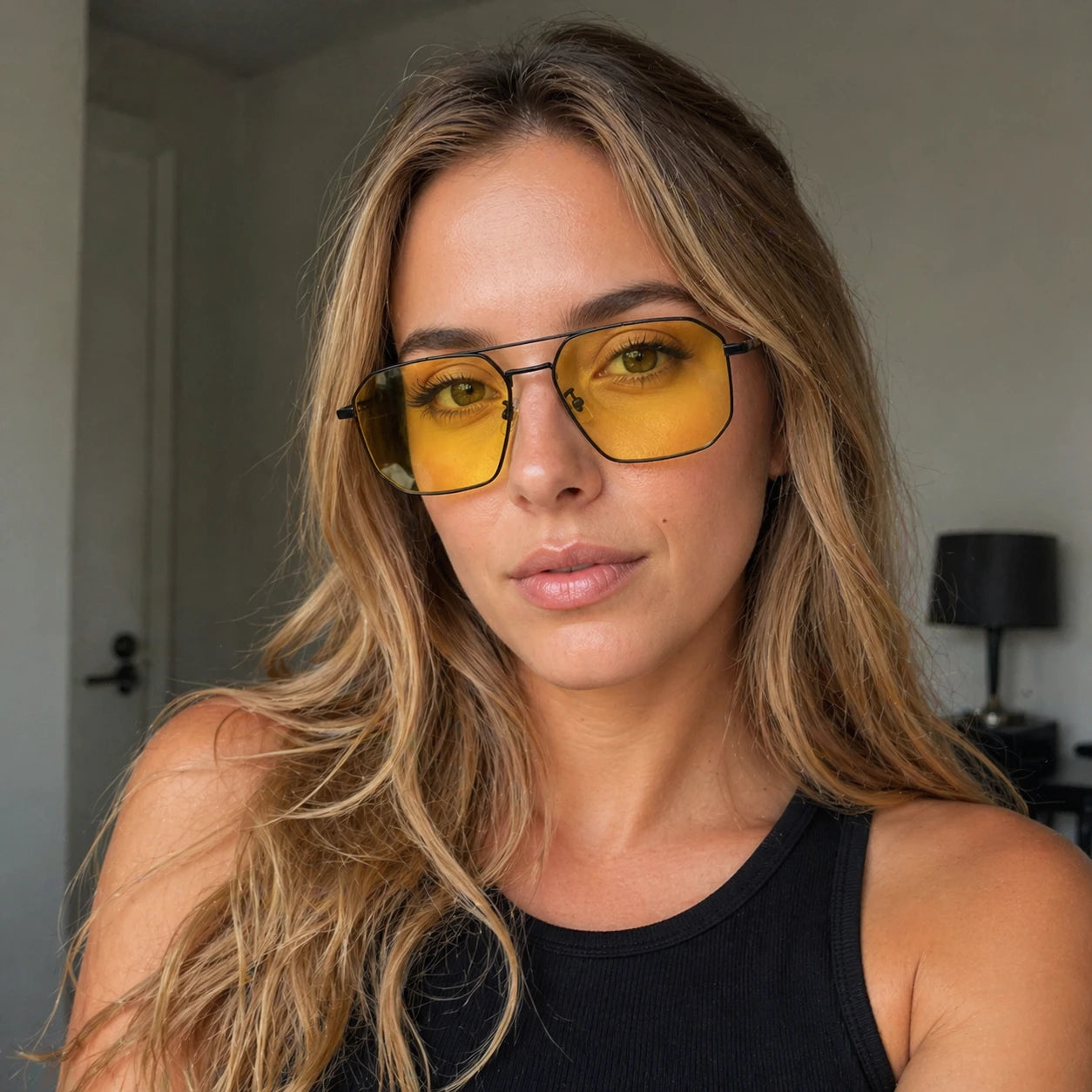


Buying shortcut: Choose Shift for daily driving and changing light, Luma for glare-heavy roads, water, and travel, or Flow when you want more bright-day coverage.

What Does Cat 3 Mean on Sunglasses?
Cat 3, also written as Category 3 or Cat. 3, is a lens category for dark sunglasses made for bright outdoor light. It describes how much visible light passes through the lens, not the frame style, lens material, or UV rating.
That is why Cat 3 is useful but incomplete. A pair can be Cat 3 and still need a separate UV400 claim. A pair can be Cat 3 and polarized, or Cat 3 and non-polarized. The label answers one question: how dark is the lens for visible light?
Cat 3 VLT: How Dark Are Category 3 Lenses?
VLT means visible light transmission. Lower VLT means a darker lens. Higher VLT means a lighter lens. Category 3 sunglasses usually sit around the 8–18% VLT range, which is why they feel appropriate for strong sun.

| Lens category | Approx. VLT | Best use | Driving note |
|---|---|---|---|
| Cat 0 | Very high VLT | Clear or very light fashion tint | Not a strong-sun lens |
| Cat 1 | Light tint | Cloudy days, low glare, soft style tint | Usually not enough for bright sun |
| Cat 2 | Medium tint | Moderate daylight, city shade, lighter daily wear | Can feel easier in changing light |
| Cat 3 | About 8–18% | Bright sun, beach, travel, open roads, daily outdoor glare | Common daytime driving direction where local rules allow |
| Cat 4 | Very low VLT | Extreme glare, snow fields, high altitude, specialist use | Generally not suitable for driving |
Is Cat 3 the Same as UV Protection or UV400?
No. This is the most important buying distinction. Cat 3 is lens darkness. UV400 is ultraviolet protection. They solve different problems.

| Label | What it tells you | What it does not tell you | Best use |
|---|---|---|---|
| Cat 3 | The lens is dark enough for bright sunlight. | It does not automatically prove UV400 protection. | Strong daylight comfort. |
| UV400 | The lens is designed to block UVA and UVB up to 400 nm. | It does not tell you how dark the lens looks. | Daily sun protection. |
| Dark lens | The lens reduces visible brightness. | Darkness alone does not prove UV safety. | Comfort only when UV protection is also clear. |
A good bright-sun pair should make both parts clear: lens darkness for comfort and UV400 or 99–100% UVA/UVB protection for protection. For the full protection framework, read the UV400 vs polarized sunglasses guide.
Are Cat 3 Sunglasses Polarized?
Not always. Cat 3 and polarized are not competing labels. They describe different features. Cat 3 describes visible darkness. Polarized describes reflected-glare reduction.
| If your problem is... | Look for... | Why |
|---|---|---|
| Strong overall brightness | Cat 3-style darkness + UV400 | The lens feels calmer in bright sun. |
| Road glare, water glare, snow glare, or wet pavement glare | Polarized sunglasses + UV400 | Polarization helps reduce reflected glare from flat bright surfaces. |
| Phone, dashboard, GPS, or HUD visibility | Test polarized lenses carefully | Polarized lenses can make some screens or dashboards harder to see. |
| Daily city wear with lighter face result | Gradient or softer visual-weight lenses | You may not need the darkest lens for every situation. |
For a deeper comparison, read Polarized vs non-polarized sunglasses and how to tell if sunglasses are polarized.
Are Cat 3 Sunglasses Good for Driving?
Cat 3 sunglasses are often a practical choice for daytime driving sunglasses because they reduce strong sunlight without being as dark as Cat 4. But driving comfort is not only about darkness.
For driving, check four things:
- Light control: the lens should reduce bright sun without making shaded roads too dark.
- Traffic visibility: lights, lane markings, signs, and dashboard details should remain easy to read.
- Glare control: polarization may help with road glare, but can affect some screens, dashboards, and HUDs.
- Fit: the frame should stay stable without temple pressure, nose sliding, or cheek touch.
If you drive through tunnels, shaded streets, or changing light, do not choose the darkest lens by default. A lens that feels excellent at noon can feel too dark in mixed light.
Cat 2 vs Cat 3 vs Cat 4 Sunglasses
Cat 3 is the practical bright-sun middle point for most daily outdoor use. Cat 2 is lighter and can feel easier in mixed city light. Cat 4 is darker and usually reserved for extreme glare, such as snow fields, high-altitude sun, and specialist outdoor conditions. Cat 4 is generally not suitable for driving.
| Compare | Cat 2 sunglasses | Cat 3 sunglasses | Cat 4 sunglasses |
|---|---|---|---|
| Brightness level | Medium tint | Dark bright-sun lens | Very dark lens |
| Best use | City shade, moderate daylight, softer daily wear | Bright sun, beach, travel, daytime driving, daily outdoor wear | Extreme glare, high mountain, snow-field conditions |
| Daily practicality | Easy in changing light | Usually the most practical bright-sun choice | Often too dark |
| Driving | Often comfortable in mixed light | Common daytime direction where permitted | Generally not suitable |
What About 3N, CE Cat 3, Filter Category 3, and UV Category 3?
Searches often include labels like 3N lens category, CE Cat 3, filter category 3, sun category 3 protection, or UV category 3. These usually point back to lens category or compliance-style labeling, but they should not replace a full product check.
Use this buying habit:
- Use Cat 3 / Category 3 / 3N as a clue for visible lens darkness.
- Use UV400 or 99–100% UVA/UVB language as the UV protection check.
- Use polarized only when reflected glare is the problem.
- Use driving suitability separately; do not assume darker is safer.
How to Choose Cat 3 Sunglasses for Bright Daylight, Driving and Glare
If you are comparing Cat 3, UV400, polarized, photochromic, and gradient lenses, start with the light problem you actually have. Do not choose by label alone.
| If your main problem is... | Choose this lens route | BAPORSSA starting point |
|---|---|---|
| Bright daytime driving | Bright-sun darkness with glare-aware lens choice | Shift / Luma |
| Road, water, or beach glare | Polarized sunglasses | Luma / Flow |
| Changing light during travel | Photochromic or gradient route | Shift / Glow |
| Daily city sun without a heavy face look | Gradient or lighter visual-weight lenses | Glow / Backbone |
| Extreme snow or high-altitude glare | Cat 4 or sport-specific eyewear | Not the main BAPORSSA route |
Simple route: choose Shift if driving and changing light are the main issue, Luma if glare and adjustable fit matter, and Flow if you want wider bright-day coverage.
For driving-specific shopping, browse Driving & Travel sunglasses. For a lighter daily look, compare Rimless Gradients.
When Should You Choose Cat 3 Sunglasses?
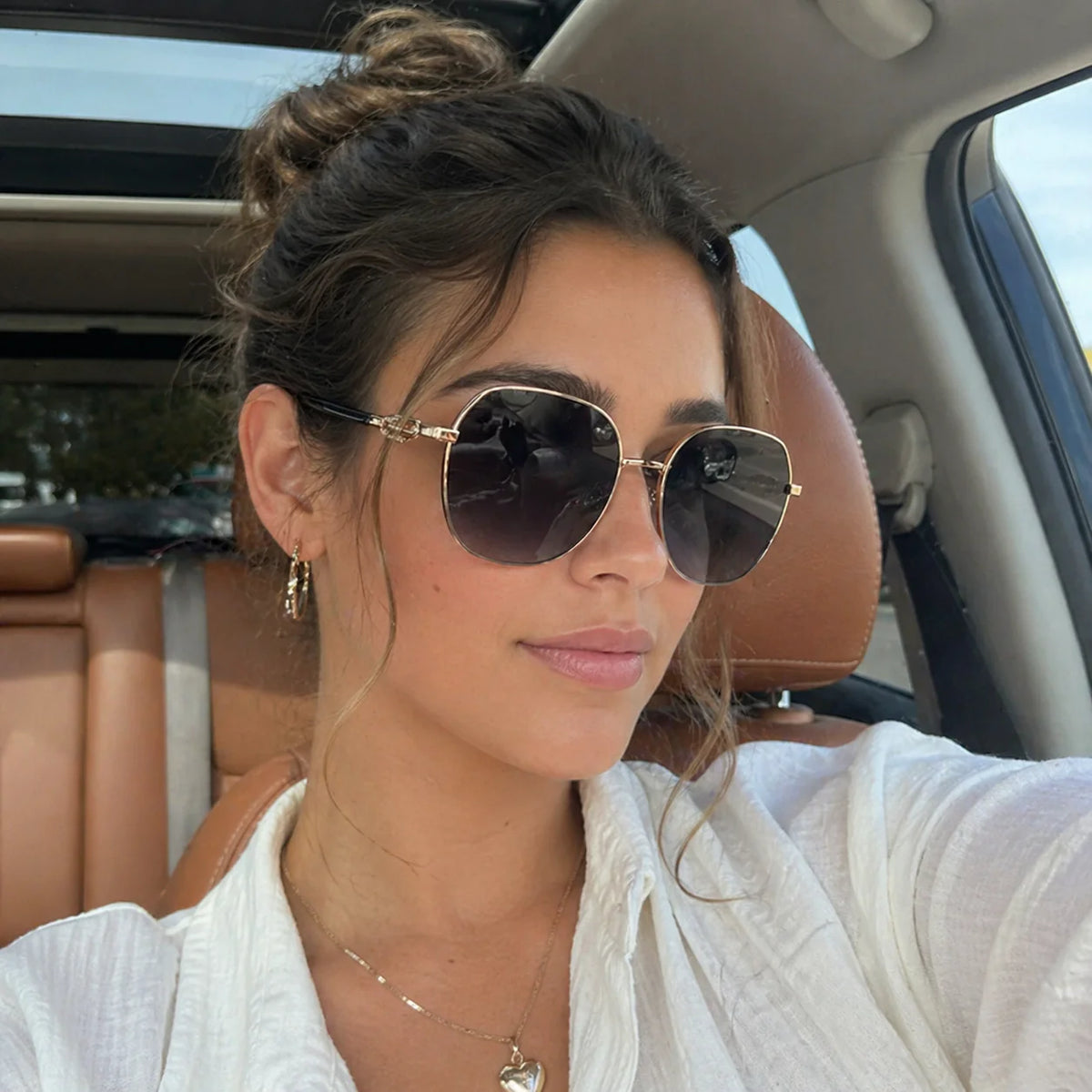
Choose Cat 3 sunglasses when your normal problem is strong daylight, not just style tint. They are most useful for bright outdoor days, open roads, beach light, sunny travel, and general summer glare.
| Situation | Cat 3 direction? | Extra check |
|---|---|---|
| Bright summer sun | Yes | Confirm UV400 protection. |
| Daytime driving | Often useful | Check dashboard, traffic signal, and shaded-road clarity. |
| Beach or water glare | Useful | Polarized may help more if reflected glare is the main issue. |
| Cloudy city days | May be too dark | Cat 2, rose, brown, or gradient may feel easier. |
| High-altitude snow glare | May not be enough | Sport-specific Cat 4 may be needed, but not for driving. |
Lens Color Still Matters
Cat 3 tells you darkness, but lens color still changes the view. Gray keeps color more neutral. Brown and bronze add warmth and contrast. Rose and pink can feel softer. Gradient lenses can make daily wear easier because the lower part of the lens stays visually lighter.

For tint decisions, read the sunglasses lens color guide. For material and clarity decisions, read the glass vs nylon vs polycarbonate sunglass lens guide.
Related Lens & Light Guides
| If you want to understand... | Read this |
|---|---|
| UV400, polarized, and visible lens darkness | UV400 vs polarized sunglasses |
| Driving glare, dashboard visibility, and lens color | Best sunglasses for driving |
| Whether polarized lenses are worth it | Polarized vs non-polarized sunglasses |
| How to test polarized sunglasses | How to tell if sunglasses are polarized |
| Photochromic vs polarized vs gradient lenses | Photochromic vs polarized sunglasses |
| Gray, brown, rose, green, and gradient lenses | Sunglasses lens color guide |
FAQ
What does Cat 3 mean on sunglasses?
Cat 3 means the sunglasses lenses are dark enough for bright outdoor light. Category 3 usually lets through about 8–18% visible light, which makes it useful for sunny days, beach light, travel, and daytime driving.
What does Category 3 sunglasses mean?
Category 3 sunglasses are sunglasses with dark bright-sun lenses. Category 3 and Cat 3 mean the same general lens category.
Is Cat 3 the same as UV400?
No. Cat 3 describes visible lens darkness. UV400 describes ultraviolet protection. A good pair should clearly state UV400 or 99–100% UVA/UVB protection separately.
What is Cat 3 UV protection?
That phrase is often confusing. Cat 3 is not UV protection by itself. It describes lens darkness. For UV protection, look for UV400 or 99–100% UVA/UVB protection.
Are Cat 3 sunglasses polarized?
Not always. Cat 3 tells you how dark the lens is. Polarized tells you whether the lens helps reduce reflected glare from roads, water, snow, glass, or bright surfaces.
Are Cat 3 sunglasses good for driving?
Cat 3 sunglasses are usually suitable for daytime driving where local rules allow, but they should still let you see dashboards, traffic signals, shaded roads, and tunnels clearly. Cat 4 sunglasses are generally not suitable for driving.
Is Cat 3 or Cat 4 better?
Cat 3 is better for most daily bright-sun use and daytime driving. Cat 4 is darker and generally reserved for extreme glare, such as snow fields or high-altitude sun, but it is generally not suitable for driving.
What does 3N mean on sunglasses?
3N is usually a lens-category marking related to Category 3. Treat it as a clue about lens darkness, then still check UV400 protection, polarization, and driving suitability.
What does VLT mean in sunglasses?
VLT means visible light transmission. It tells you how much visible light passes through the lens. Lower VLT means a darker lens.
What is the best lens category for sunglasses?
For most daily bright-sun sunglasses, Cat 3 is the most practical category. For lighter city wear, Cat 2 or gradient lenses may feel easier. For extreme glare, Cat 4 may be used in sport-specific conditions, but not for driving.
Should I choose Cat 3, polarized, or photochromic sunglasses?
Choose Cat 3-style darkness for strong sun, polarized lenses for reflected glare, and photochromic lenses for changing light. Many real-life sunglasses combine more than one feature, so check the product details carefully.
Final Buying Check
- If the sun feels harsh, check lens category or VLT.
- If UV protection matters, check UV400 or 99–100% UVA/UVB language.
- If road, water, or beach glare bothers you, check polarization.
- If you drive, check dashboard, HUD, GPS, and shaded-road visibility.
- If you wear sunglasses for hours, check frame weight, nose pads, and temple pressure.
Cat 3 sunglasses are useful when you need bright-day comfort. They are not the whole answer. The best pair combines the right darkness, clear UV protection, the right glare control, and a fit you will actually keep wearing.