
To tell if sunglasses are polarized, do not judge by lens darkness. Use a phone or laptop screen, a second known polarized lens, a real glare source such as water or wet pavement, or a proper polarized test card. A strong darkening effect when the lens is rotated—or a clear reduction in reflected glare—usually indicates polarization.
Polarization, UV400 protection, and tint darkness are separate features. Polarization reduces reflected glare. UV400 describes ultraviolet protection. Tint darkness reduces visible brightness. A lens can have one, two, or all three.

Quick Answer: Five Ways to Test Polarized Sunglasses
| Test | What to do | Likely polarized result |
|---|---|---|
| Phone or laptop screen | Hold one lens over a bright screen and rotate it 60–90 degrees. | The screen becomes much darker at a particular angle. |
| Two-lens 90° test | Overlap the test pair with a pair you know is polarized, then rotate one pair. | The overlapping area becomes nearly black around 90 degrees. |
| Water, road, or glass glare | Compare a bright reflection with and without the sunglasses. | The reflection looks softer, flatter, or less blinding. |
| Polarized test card | Look through the lens at a proper test card and rotate the lens. | A hidden image or contrast pattern appears or changes strongly. |
| Product specifications | Check the product page, packaging, or manufacturer information. | The lens is explicitly described as polarized. |
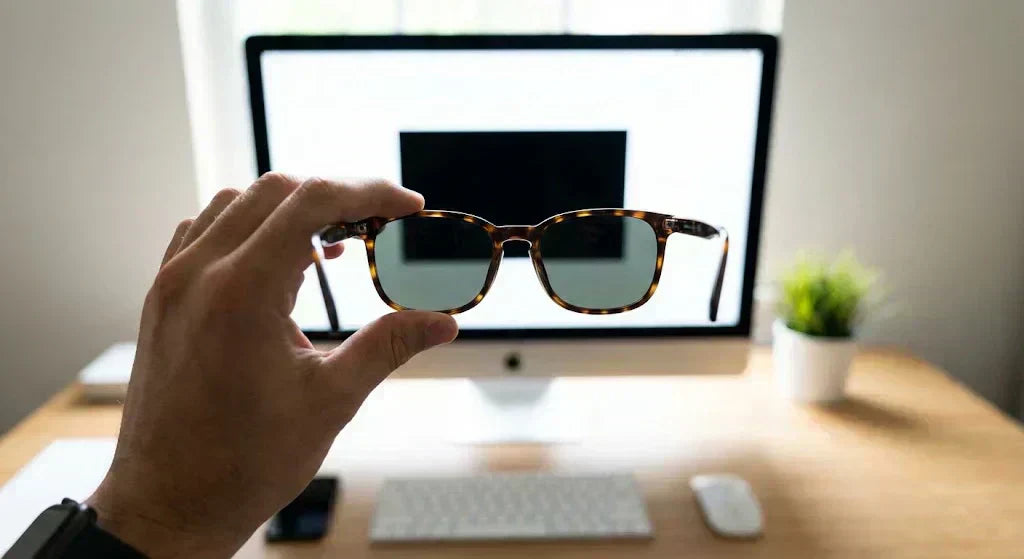
1. Phone Screen Test
Many LCD screens use polarized light, which makes a phone, tablet, laptop, GPS display, or dashboard useful for a quick test.
- Turn the screen brightness up.
- Open a mostly white page.
- Hold one sunglass lens in front of the screen.
- Rotate the sunglasses slowly from horizontal to vertical.
- Watch for a strong change in brightness.
Likely polarized: the display becomes dramatically darker at one angle and brightens again as you continue rotating.
Inconclusive: the screen changes only slightly, shows a color shift, or does not change. Screen technology, screen protectors, viewing angle, and brightness can affect the result, so repeat the test on another device or use the two-lens test.

The same effect can matter after purchase. Some polarized sunglasses make digital dashboards, phones, GPS screens, or head-up displays harder to read at certain angles. For that tradeoff, see our polarized sunglasses and screen visibility guide.
2. Two-Lens 90-Degree Test
This is usually the strongest at-home method when you already own one pair that is definitely polarized.
- Hold the known polarized pair in front of you.
- Place the pair you want to test behind it.
- Look through the overlapping lens area.
- Rotate one pair approximately 90 degrees.
If both lenses are polarized, the overlapping area should become very dark. Each lens filters light in a different direction, so crossing the filters blocks much more light.

If the overlap remains almost unchanged, the test pair may not be polarized. Make sure the reference pair is genuinely polarized before relying on this result.
3. Real-World Glare Test
Polarized lenses are designed for reflected glare, so a reflective outdoor surface can be more useful than simply looking through a dark lens indoors.
Good test surfaces include:
- Water
- Wet pavement
- Car windshields
- Glass storefronts
- Snow
- Glossy vehicle surfaces
Look at the reflection without the sunglasses, then look again through the lenses. Tilt the sunglasses slightly. A polarized lens should make harsh surface glare look calmer and less intense. On water, it may also make details beneath the surface easier to see.

This test is especially relevant if you are choosing sunglasses for daytime driving, commuting, beach use, boating, fishing, or bright city streets. For driving-specific choices, continue with our driving sunglasses guide.
4. Online Test Images and Polarized Test Cards
An online polarized test image can be a convenient first check, but it is not a laboratory certification. The result depends on the screen, browser, brightness, viewing angle, and the way the test image was created.
A proper physical polarized test card is generally more consistent. These cards contain an image or pattern that changes when viewed through a polarized filter. Rotate the lens slowly and watch for a strong contrast change.
Use an online image or test card to check lens behavior, not to prove every aspect of lens quality. Neither method confirms UV400 protection, optical clarity, scratch resistance, coating durability, or the correct tint category.
What Your Test Result Means
| Your result | What it probably means | Better next step |
|---|---|---|
| The screen becomes very dark when rotated | The lens is likely polarized. | Confirm UV400, tint category, screen readability, and fit. |
| Two overlapping lenses become nearly black at 90° | Both lenses are likely polarized. | Compare frame comfort, coverage, lens color, and intended use. |
| Road or water glare stays harsh | The lens may be non-polarized or the glare reduction may be weak. | Compare the Driving & Travel collection. |
| The lens is dark, but reflections remain sharp | The lens is tinted, but darkness alone does not prove polarization. | Read UV400 vs polarized sunglasses. |
| The screen becomes hard to read | This can be a normal polarized-lens tradeoff. | Test your own dashboard, phone, GPS, or HUD before relying on the pair. |
| You want glare control with less visible frame weight | Lens function and frame appearance are separate decisions. | Compare Signature Rimless sunglasses. |
| The result is unclear | The screen or test method may be inconclusive. | Repeat the two-lens test and verify the product specifications. |
BAPORSSA route: choose by the problem you are solving. For road glare and travel use, start with the Driving & Travel collection. For a lighter, cleaner-face appearance, compare the Signature Rimless collection. Check each product page for exact lens and fit specifications before buying.
Polarized vs UV400 vs Dark Tint
| Feature | What it does | What it does not prove |
|---|---|---|
| Polarized | Reduces reflected glare from flat, bright surfaces. | It does not automatically prove UV400 protection. |
| UV400 | Describes ultraviolet protection up to 400 nanometers. | It does not automatically mean the lens is polarized. |
| Dark tint | Reduces visible brightness. | It does not prove polarization or UV400. |
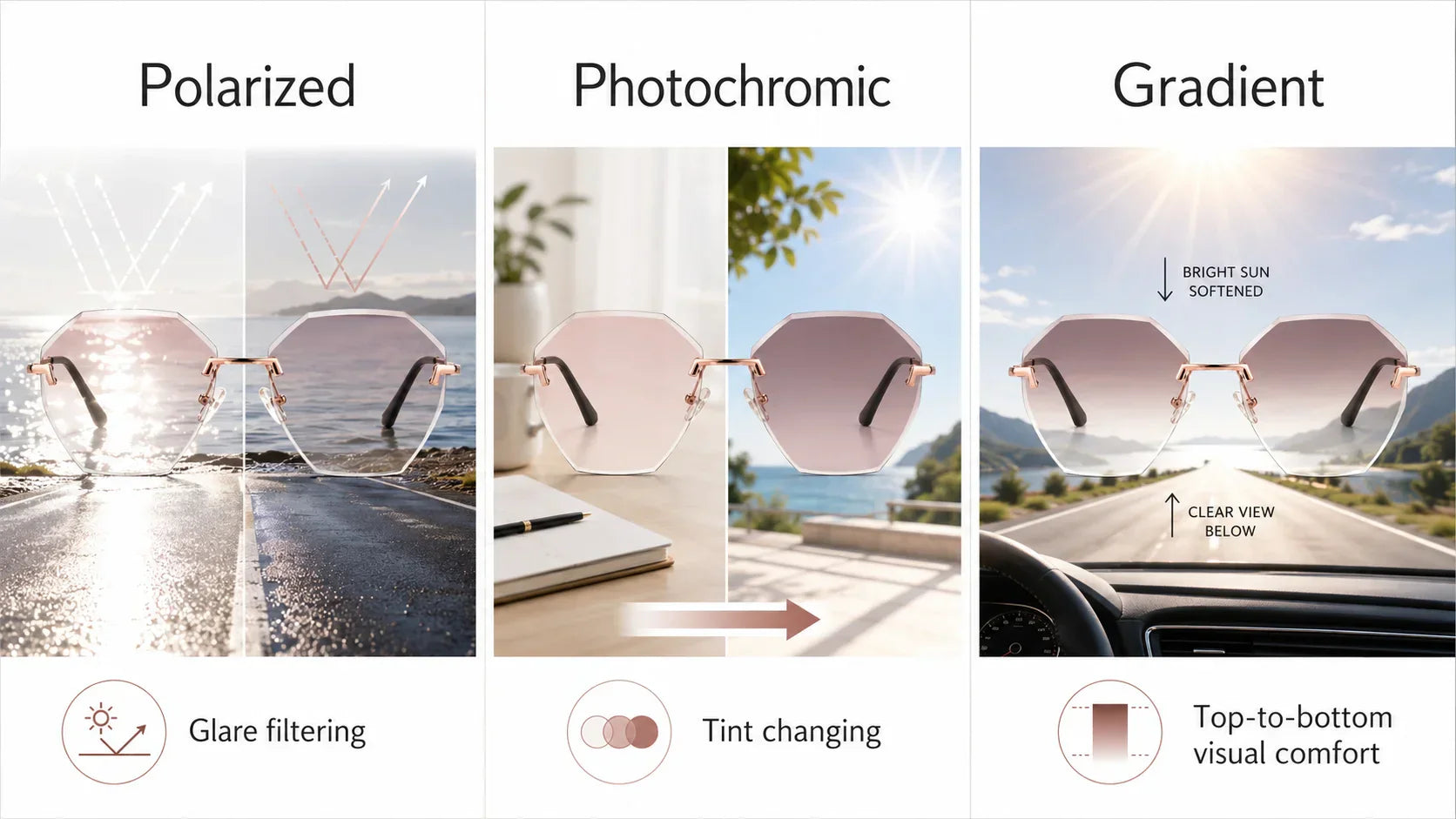
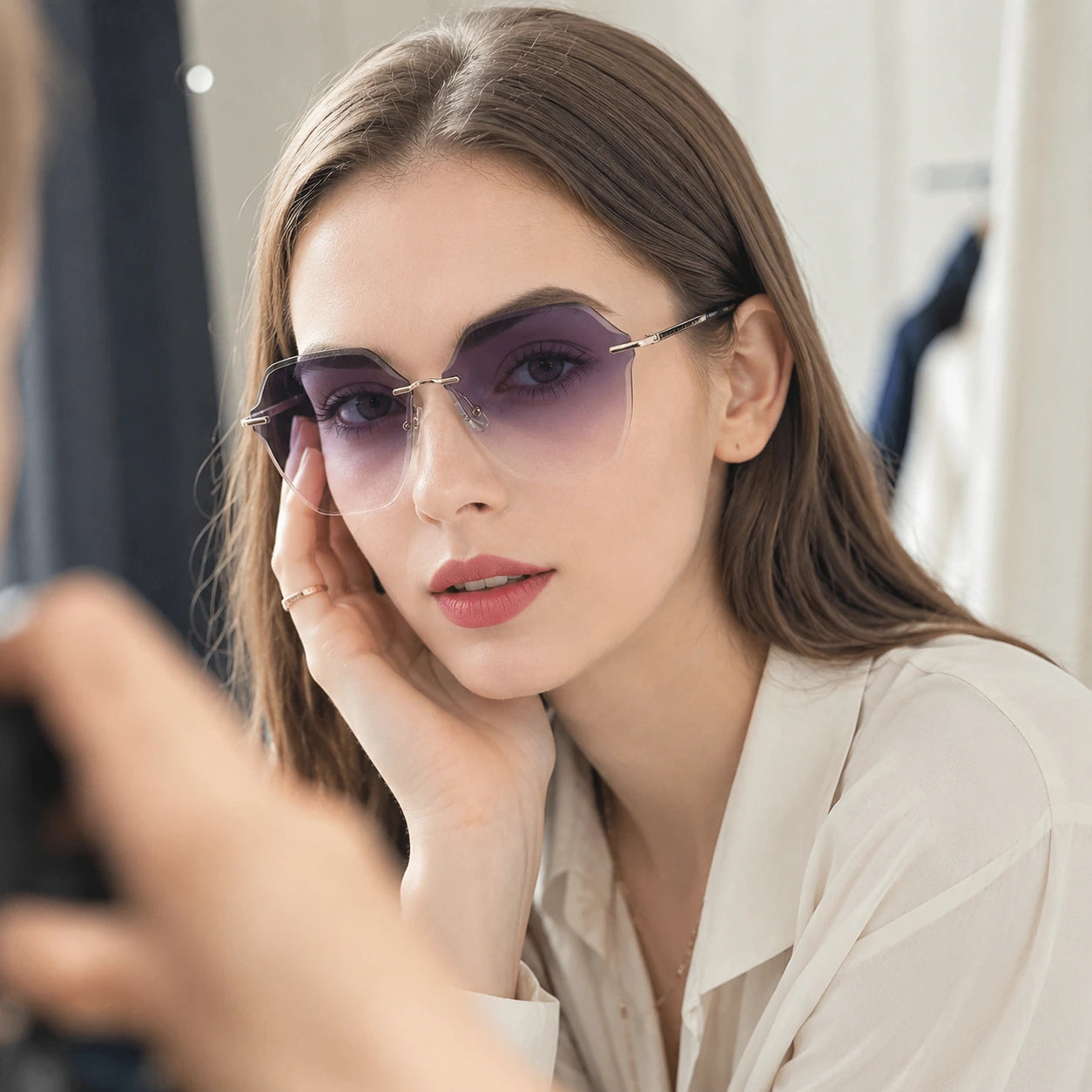
| Gradient tint | Is darker at the top and lighter at the bottom. | It is polarized only when polarization is listed separately. |
| Photochromic | Changes tint in response to light conditions. | It is not automatically polarized. |
For a broader comparison, read photochromic vs polarized sunglasses. To understand lens darkness and visible light transmission, see our Category 3 and VLT guide.
When Polarized Sunglasses Are Worth Choosing
Polarized sunglasses are most useful when reflected glare is the main problem. Typical situations include bright daytime driving, wet roads, water, beach use, snow, and glass-heavy urban environments.
They are not automatically the best answer for every person or activity. Before buying, consider:
- Screen visibility: test phones, dashboards, GPS displays, and HUDs.
- Tint category: choose darkness for the actual light conditions.
- Coverage: wider lenses can help when glare enters from the side.
- Fit: a lens feature cannot compensate for a frame that slips, pinches, or sits incorrectly.
- Face visibility: frame weight, lens tint, and lens shape affect how open or covered the face looks.
For cases where polarization may not be the best choice, read polarized vs non-polarized sunglasses.
What to Check Before Buying
A polarized test answers only one question: whether the lens behaves like a polarized filter. Before purchasing a new pair, confirm the complete specification:
- Polarization
- UV400 protection
- Tint category or VLT when available
- Lens material
- Frame width and bridge fit
- Temple comfort
- Screen and dashboard readability for your use case
Do not assume lens quality from price, color, darkness, or marketing terms such as “HD.” Use the exact product specifications and choose the frame based on how and where you will wear it.
FAQ
How can I tell if sunglasses are polarized?
Rotate the lenses over a bright phone or laptop screen, use a known polarized lens for a 90-degree overlap test, compare glare on water or wet pavement, or use a proper polarized test card. A strong darkening or glare-reduction effect usually indicates polarization.
Is the phone screen test reliable?
It is useful but not perfect. Screen type, brightness, screen protectors, and viewing angle can affect the result. Confirm an unclear result with the two-lens test or a real glare test.
Does a dark lens mean the sunglasses are polarized?
No. Dark tint reduces visible brightness. Polarization reduces reflected glare. A very dark lens can still be non-polarized.
Are polarized sunglasses always UV400?
No. Polarization and UV400 are separate features. Check the product specifications for both.
Why do polarized sunglasses make my phone or dashboard look dark?
Many digital displays use polarized light. At certain angles, the display’s light direction and the sunglass filter can conflict, making the screen look dim, uneven, rainbow-like, or nearly black.
What is the most reliable at-home polarized test?
The two-lens 90-degree test is usually the clearest method if the reference pair is definitely polarized. A real-world glare test is also useful when driving or water glare is the reason you are considering polarization.
Should I replace sunglasses that fail the polarized test?
Only if reflected glare is a problem you need to solve. If the current pair is comfortable and you mainly need basic brightness reduction, polarization may not be essential. If road, water, wet-pavement, snow, or glass glare remains harsh, compare a properly specified polarized pair.