


Quick answer: if your sunglasses are peeling, the issue is usually lens coating damage, heat crazing, or lens delamination. It is not always dirt, and it is not always something you can polish away.
The first job is diagnosis. Peeling coating, scratches, sunscreen film, cloudy residue, bubbles, and crazing can look similar, but they lead to different decisions. A dirty lens can be cleaned. A damaged coating usually cannot be restored at home.
If you are searching for sunglasses repair, replacement lenses, glasses lens peeling, glasses crazing, or how to fix peeling glasses lenses, the key question is not only what caused the damage. The real question is whether the lens can still give you clear, comfortable vision—or whether it is time to replace the lenses or upgrade to a better daily pair.
| What you see | Most likely issue | Best next step |
|---|---|---|
| Flaky edge or patchy clear layer | Lens coating peeling | Stop rough wiping; consider replacement if it spreads. |
| Spiderweb-like fine lines | Heat crazing | Replace the lens or pair if vision is affected. |
| Cloudy film that changes after gentle cleaning | Sunscreen, oil, or salt residue | Clean gently before deciding it is damage. |
| Small bubbles or lifted spots | Delamination or coating separation | Replacement is usually smarter than polishing. |
| Single sharp line or scuff | Scratch | Do not aggressively polish coated lenses. |

Quick Route: If Your Old Sunglasses Are Peeling
No product should be described as peel-proof forever. Heat, sunscreen, saltwater, scratches, and cleaning habits can damage any lens surface over time. The better buying question is: how did your old pair fail, and what verified product route makes more sense next?
| If your old pair failed because... | BAPORSSA route | Verified reason |
|---|---|---|
| The lens edge looked rough or flaky | Contour | Product specs list Nylon lens, UV Protection, HD, AR, Scratch-Resistant, Hydrophobic coatings, adjustable nose pads, and 47 reviews. |
| The pair felt heavy or not worth saving | Air | Product parameters list Premium Nylon; product specs list Nylon lens, UV Protection and HD coatings; recent behavior shows add-to-cart, checkout, and purchase. |
| You want the strongest recent product-interest signal | Backbone | Product specs list Nylon lens, UV Protection, HD, Scratch-Resistant coating, 22g weight, adjustable nose pads, and the strongest recent product-interest route. |
| You want the strongest verified material and review proof | Onyx | Product specs list Beta Titanium, Nylon polarized lens, Scratch-Resistant and AR coatings, Cat. 3 VLT, 20g weight, and 95 reviews. |


Why Are My Sunglasses Peeling?
Sunglasses usually peel because the lens coating is no longer bonded cleanly to the lens surface. Depending on the lens design, that coating may include tint, UV protection, mirror finish, anti-reflective treatment, water-repellent treatment, scratch-resistant treatment, or polarization-related layers.
Once a coating starts lifting, the edge can look flaky, cloudy, bubbly, or patchy. Wiping harder usually makes it worse because the issue is no longer simple surface dirt.
Peeling, Crazing, Scratches or Delamination?

| Issue | How it looks | Common cause | What to do |
|---|---|---|---|
| Coating peeling | Patchy lifting, flakes, cloudy islands | Heat, sunscreen residue, rough cleaning, age | Replace if it affects vision or keeps spreading. |
| Crazing | Fine crack lines like a spiderweb | Heat stress or coating expansion mismatch | Usually not repairable at home. |
| Delamination | Bubbles, separation, uneven layers | Layer separation inside or on top of the lens | Replacement is usually smarter than polishing. |
| Scratches | Sharp lines or scuffs | Sand, rough cloths, dry wiping | Avoid aggressive polishing. |
| Residue | Greasy or cloudy film that changes when cleaned | Sunscreen, oil, saltwater, makeup | Clean gently first. |
Why Lens Coating Comes Off
Lens coatings fail when stress keeps repeating. One hot day may not ruin a pair, but repeated heat, sweat, sunscreen residue, saltwater, and rough wiping can weaken the surface over time.
- Heat: hot cars, dashboards, saunas, and direct sun storage can stress lens coatings.
- Sunscreen and skin oil: residue can sit on the lens surface and around lens edges.
- Saltwater and sweat: dried salt increases cleaning friction.
- Dry wiping: dust and sand act like abrasives.
- Unapproved cleaners: strong cleaners may affect coatings or frame finishes.
- Age: older coatings can become easier to lift, haze, or crack.
Can Peeling Sunglasses Be Fixed?
Sometimes you can clean residue that looks like peeling. But once the lens coating is actually lifting, bubbling, cracked, or separating, it usually cannot be restored to a clear factory finish at home.
| Situation | Try gentle cleaning? | Replace? |
|---|---|---|
| Cloudy sunscreen film | Yes | Only if cleaning fails. |
| Small edge flaking | Gentle cleaning only | Likely if it spreads. |
| Spiderweb crazing | No real fix | Yes if it affects vision. |
| Bubbles or layer separation | Cleaning will not rebond it | Usually yes. |
| Peeling in the center of view | No | Yes. |
Repair, Replacement Lenses, or a New Pair?
Many people search for sunglass repair or replacement lenses because they want to save a pair they already own. That can make sense if the frame is expensive, the lenses are easy to replace, and the repair cost is reasonable. But if the lenses are peeling, crazed, cloudy, or scratched across the viewing area, repair is not always the better value.
| Decision | When it makes sense | When to avoid it |
|---|---|---|
| Clean the lenses | The mark moves, smears, or improves with gentle cleaning. | The coating shape stays fixed or keeps spreading. |
| Replace lenses | The frame is still strong and compatible replacement lenses are easy to source. | The frame is loose, warped, corroded, or replacement lenses cost close to a new pair. |
| Repair locally | The problem is a loose screw, bent temple, or nose pad issue. | The issue is coating peel, heat crazing, or delamination in the lens. |
| Upgrade to a new pair | The damage affects vision, comfort, or daily wear confidence. | The issue is only light residue that can be safely cleaned. |
Buying logic: if repair only delays the same problem, choose a new pair based on your real use case: daily glare, changing light, water reflection, driving, travel, or a cleaner face look.
Brand-Name Coating Issues: What to Learn From Them
Searches around Ray-Ban lens peeling, Oakley coating coming off, Maui Jim repair, and replacement lenses usually come from the same frustration: the old pair was expensive, but the lenses no longer feel clear enough to wear. This does not mean one brand or one coating is always bad. It means lens surfaces are still exposed to heat, cleaning habits, sunscreen, sweat, salt, and age.
The useful lesson is not to look for a magic coating that can never fail. The useful lesson is to choose the next pair with clearer expectations: verified lens material, realistic care instructions, UV400 protection, polarized or gradient function where needed, and a frame you will actually protect in daily use.
What to Avoid on Peeling Sunglass Lenses
The main mistake is trying to scrub coating damage away. Peeling is not dirt. Delamination is not a smudge.
| Avoid | Why |
|---|---|
| Abrasive household hacks | They can strip coatings unevenly. |
| Dry paper towels or clothing | They can drag grit across the lens surface. |
| Strong unapproved cleaners | They may affect coatings or frame finishes. |
| Hot water or heat exposure | Heat can stress coatings further. |
| Pulling at lifted film | It can create uneven optics and more damage. |
When to Replace Peeling Sunglasses
Replace the pair or lenses when the damage sits in your main view, keeps spreading, causes glare, creates haze, or makes your eyes work harder. A damaged coating can be more distracting than a simple dark lens.
- the peeling is in the center of the lens;
- the lens looks cloudy even after gentle cleaning;
- crazing appears across a large area;
- polarized lenses show bubbles or uneven patches;
- the coating damage creates glare, halos, or distortion;
- the frame is old enough that replacement costs more effort than it saves.
What to Look For in Your Next Pair
- Verified lens material: nylon or another lens material clearly listed in product specs.
- Coating information: look for named coatings such as UV Protection, HD, AR, Scratch-Resistant, or Hydrophobic when available.
- Lower weight: lighter frames usually feel easier to wear and store properly.
- Clean lens edges: especially important for rimless sunglasses where the lens edge is visible.
- Realistic care instructions: no pair should depend on harsh polishing to stay usable.
For a material-level comparison, read the glass vs polycarbonate vs nylon lens material guide. For frame build quality, read the sunglasses material guide.
BAPORSSA Route: Choose by How the Old Pair Failed
| Product | Best replacement route | Verified product basis |
|---|---|---|
| Contour | Lens-edge and coating-conscious replacement | Nylon lens; UV Protection, HD, AR, Scratch-Resistant, Hydrophobic coatings; adjustable nose pads; 28g; 47 reviews. |
| Air | Lighter daily replacement | Premium Nylon product parameter; product specs list Nylon lens, UV Protection and HD coatings; 28g; strongest recent checkout and purchase signal in this group. |
| Backbone | Clean rimless route with strong product behavior | Nylon lens; UV Protection, HD, Scratch-Resistant coating; 22g; adjustable nose pads; strongest recent product-interest and add-to-cart route. |
| Onyx | Verified material and review-proof route | Beta Titanium frame; Nylon polarized lens; UV Protection, Scratch-Resistant, AR coatings; Cat. 3 VLT; 20g; 95 reviews. |


Upgrade Route: Choose by Real-World Use
If your old lenses are peeling, crazed, scratched, or cloudy in the viewing area, a repair may not restore clear vision. Choose the replacement route based on where your old pair failed and where you actually wear sunglasses.
| Your use case | Better route | Why |
|---|---|---|
| Clean everyday styling | Backbone | Clean rimless gradient route with lower visual bulk. |
| Daily glare and adjustable comfort | Luma | Polarized daily route with adjustable nose pads and lighter metal comfort. |
| Changing light | Glow | Photochromic and gradient route for days when light conditions keep shifting. |
| Bright outdoor light or water glare | Flow | High-coverage polarized route for stronger outdoor use. |


Where Luma, Vanguard, Flow and Glow Fit
- Luma fits the adjustable metal comfort route. Product specs list Aluminum-Magnesium, Nylon lens, UV Protection, HD, Scratch-Resistant, and AR coatings.
- Vanguard fits the rimless shield route. Product specs list High-Nickel Cupronickel, Nylon lens, UV Protection, HD, AR, and Scratch-Resistant coatings. It should not be described as titanium.
- Flow fits the high-coverage polarized route. Product specs list Nylon lens, Polarized, UV Protection, HD, and Scratch-Resistant coatings.
- Glow fits the photochromic and changing-light route. It is useful for light adaptation, but this article uses stronger review and product-behavior proof for the main route.
How to Stop New Sunglasses From Peeling
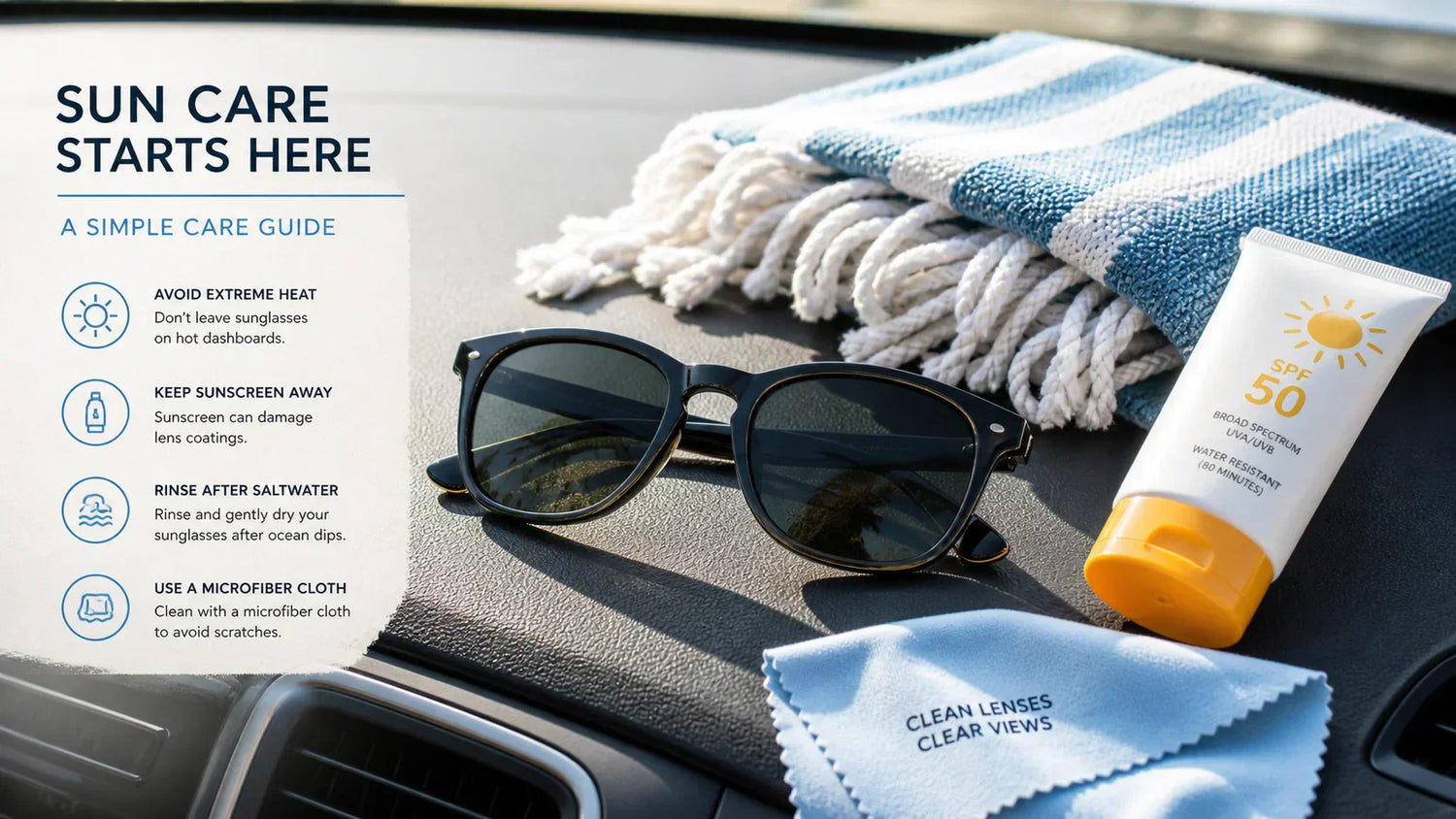
- Do not leave sunglasses on a dashboard or inside a hot car.
- Rinse beach sand, sweat, and saltwater before wiping.
- Use microfiber, not paper towels or clothing.
- Keep sunscreen residue off the lenses when possible.
- Use a gentle lens-safe cleaning routine.
- Store sunglasses in a case, not loose in a bag.
- Do not polish coated lenses with abrasive products.

Related Craft & Lens Guides
| If your issue is... | Read this next |
|---|---|
| Lens material quality | Glass vs polycarbonate vs nylon lenses |
| Frame and material quality | Sunglasses material guide |
| Always dirty or smudged lenses | Why are my sunglasses always dirty? |
| Green buildup around nose pads | Green stuff on glasses nose pads |
| UV vs polarized confusion | UV400 vs polarized sunglasses |
| Polarized lens testing | How to tell if sunglasses are polarized |
| Changing-light lenses | Photochromic vs polarized sunglasses |
| Choosing a better next pair | BAPORSSA sunglasses buying guide |
FAQ
Why are my sunglasses peeling?
Your sunglasses are usually peeling because the lens coating is lifting, cracking, or separating from the lens surface. Heat, sunscreen residue, saltwater, rough cleaning, strong cleaners, age, and dry wiping can all contribute.
Can peeling sunglasses be fixed?
Residue that looks like peeling can sometimes be cleaned. Real coating peeling, crazing, or delamination usually cannot be restored at home to a clear factory finish.
How do I remove peeling from sunglass lenses?
You usually should not try to remove peeling coating with abrasive products. Clean gently first. If the coating is actually lifting, replacement is usually safer than polishing.
Is lens delamination the same as peeling?
They are related but not always identical. Peeling usually describes a coating lifting from the surface. Delamination describes layers separating, which may look like bubbles, patches, or cloudy separation.
What is crazing on sunglasses?
Crazing looks like fine spiderweb cracks or stress lines on or within the lens coating. It is often linked to heat stress and is usually not fixable with cleaning.
What is glasses crazing?
Glasses crazing means fine stress cracks in or on the lens coating. It often appears after heat exposure or coating stress. On sunglasses, it can make the lens look cloudy, cracked, or harder to see through.
Do polarized sunglasses peel?
Polarized sunglasses can peel or delaminate if lens layers or coatings are damaged. Polarization does not make a lens immune to heat, cleaners, scratches, or age.
Can sunscreen damage sunglass lenses?
Sunscreen can leave oily residue and may contribute to coating stress if it sits on lenses repeatedly. Clean sunglasses gently after sunscreen-heavy wear.
Can sunglass lenses be repaired?
Small hardware problems may be repairable, and some frames can accept replacement lenses. But coating peel, heat crazing, delamination, and deep scratches across the viewing area are usually not fully repairable at home.
Should I replace lenses or buy new sunglasses?
Replace lenses if the frame is still strong and compatible lenses are easy to source. Buy a new pair if the frame is old, loose, warped, or if replacement lenses cost close to a new pair.
When should I replace peeling sunglasses?
Replace them when peeling, crazing, bubbles, or haze sit in your main view, keep spreading, create glare, or make the lenses uncomfortable to look through.
Are scratch-resistant lenses peel-proof?
No. Scratch-resistant is not the same as peel-proof. It can help with surface durability, but lens coatings still need proper care and can still be damaged by heat, cleaners, or abrasion.
Final Recommendation
If your sunglasses are peeling, do not keep scrubbing them. Clean once gently to rule out sunscreen or oil residue. If the shape of the damage stays fixed, spreads, bubbles, or cracks, treat it as coating damage rather than dirt.
For your next pair, choose by the failure pattern. Contour is the strongest coating-conscious lens-edge route, Air is the lighter daily replacement route, Backbone is the cleaner rimless route with strong recent product behavior, and Onyx is the strongest verified material and review-proof route.
Upgrade by use case: choose Backbone for clean daily styling, Luma for daily polarized comfort, Glow for changing light, or Flow for stronger outdoor glare.