Why is There Green Gunk on My Glasses? (It’s Not Mold, It’s Chemistry)
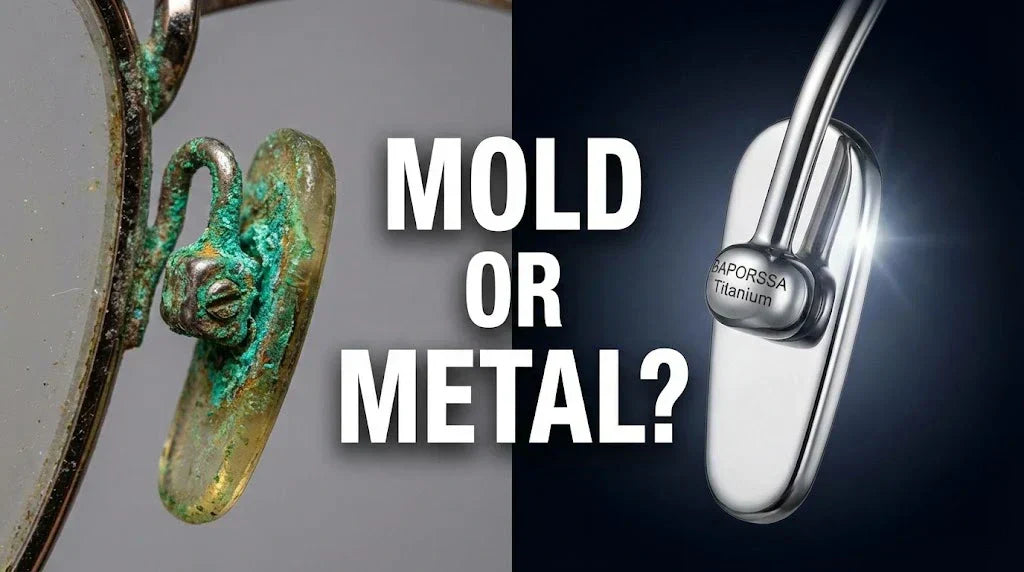
You take off your glasses after a long, hot day. You look at the nose pads, and there it is: a buildup of slimy, bright green gunk. Even worse, it might have left a matching green stain on the bridge of your nose.
Is it mold? Is it algae? Is your face... rotting?
Relax. It’s not biological. It’s chemical.
While it looks gross, that green sludge is actually a science experiment happening right on your face. It is the surest sign that your eyewear is made of low-quality materials.
Here is the chemical explanation of the "Green Gunk," how to clean it safely, and why upgrading your frame material is the only permanent cure.

The Diagnosis: What is the "Green Slime"?
First, let's debunk the myth. That green stuff is not mold. It is not growing, and it is not alive.
The Chemistry: The "Statue of Liberty" Effect
The Statue of Liberty is made of Copper. It used to be shiny brown. Now, it is green. Why? Oxidation.
The green gunk on your glasses is essentially the same thing. It is a compound called Copper Carbonate (or sometimes Copper Chloride).
- The Ingredients:
-
- Copper: Found in the base metal of cheap frames (Monel or Nickel Silver).
- Acidity: Found in your sweat and skin oils (Sebum).
- Oxygen: Found in the air.
- The Reaction: When the acid in your sweat hits the copper in the frame, it dissolves the metal slightly. This mixture reacts with oxygen to form a green paste (Verdigris).
The Skin Risk
Is it dangerous? Generally, no. It is not toxic in small amounts.
However, it is a skin irritant. The rough, acidic crystals can cause Contact Dermatitis (red, itchy rash) and clog the pores on your nose bridge, leading to "glasses acne."
The Culprit: Cheap Alloys (Monel & Nickel Silver)
"But my glasses are gold/silver! Why are they turning green?"
The "Base Metal" Problem
Most eyewear under $100 is not made of solid gold or silver. It is made of a "Base Metal" alloy—usually Monel (a mix of Copper and Nickel) or Nickel Silver (Copper, Nickel, Zinc)—which is then plated with a thin layer of color.
Over time, your sweat eats through the microscopic plating. Once the plating is breached, the underlying copper is exposed to your skin, and the green oxidation begins.
The "Acid" Factor
Why does this happen to you but not your friend?
It might be your pH Level. Some people have more acidic sweat than others. If you have "high acid" skin, you are essentially a walking corrosion machine for cheap metal.
The Permanent Cure: Titanium (The Inert Metal)
You can clean the gunk (we'll explain how below), but if you wear alloy frames, it will come back. The chemistry is inevitable.
The only way to stop it is to remove the Copper from the equation.
Why Titanium Cannot Turn Green
Titanium is an Inert Metal.
- No Copper: It contains zero copper.
- Oxide Shield: Titanium naturally forms a microscopic, impenetrable oxide film that prevents it from reacting with oxygen or acid.
This is why BAPORSSA Titanium Frames are used by surgeons and marine engineers. You could leave a titanium frame in a bucket of saltwater for 10 years, and it would not form green corrosion.
No Copper = No Reaction = No Green Gunk.

How to Remove the Green Gunk (If You Can't Upgrade Yet)
If you are stuck with alloy frames for now, you need to clean them deeply. Surface wiping isn't enough.
1. The Ultrasonic Method (Best)
The green crystals often form inside the tiny screw box where the nose pad connects. A toothbrush can't reach there.
Take your glasses to an optician. An Ultrasonic Cleaner uses sound waves to vibrate the water, blasting the calcified gunk out of the microscopic crevices.
2. The DIY Paste (Home Fix)
If you can't get to a shop:
- Mix: Mild dish soap + a pinch of baking soda (to act as a gentle abrasive).
- Scrub: Use a soft-bristled toothbrush to scrub the nose pad arms.
- Rinse: Flush thoroughly with warm water.
- Dry: Use a microfiber cloth. Note: This will remove the gunk, but it won't fix the pitted metal, so the green will return.
Nose Pad Hygiene 101
Sometimes the metal is fine, but the plastic pad is gross.
Why do nose pads turn yellow?
This is UV Degradation.
Most clear nose pads are made of PVC or soft Silicone. Over time, UV rays and skin oils cause the plastic polymers to break down and discolor.
- The Fix: Nose pads are like toothbrushes—they are disposable. We recommend changing them every 6–12 months. It’s a $5 maintenance step that keeps your face hygienic.
The "Rinse Rule"
The best way to delay corrosion on alloy frames is to remove the fuel (sweat).
Rule: Every time you take your sunglasses off for the day, rinse them under lukewarm tap water. If you leave sweat sitting on the metal overnight, you are giving the chemistry 8 hours to work.
Conclusion: Green Belongs on Trees, Not Your Face
Green gunk isn't a mystery; it's a warning sign. It tells you that your eyewear plating has failed and the metal is rotting against your skin.
You can scrub it off every week, or you can solve the chemistry problem permanently.
Upgrade to the purity of Titanium. Your skin will thank you.
Sources & References
- Corrosion Doctors: Atmospheric Corrosion of Copper — The chemistry of verdigris and oxidation.
- Mayo Clinic: Contact Dermatitis & Nickel Allergy — Health risks of corroding base metals.
- Azom (Materials Science): Titanium Corrosion Resistance — Why titanium is inert.
BAPORSSA Editor's Selection

The Amber Titanium
Ultra-lightweight 16g aerospace titanium meets high-clarity optics. Designed for the minimalist luxury aesthetic.
SHOP THE SELECTION