Why Your Sunglasses Need to Manage Blue Light (HEV)
When you hear "Blue Light," you probably think of your laptop screen, your smartphone, or those clear "computer glasses" everyone wears at the office.
But here is a reality check: The sun emits 100 times more blue light than your digital screen.
While we have been trained to fear UV rays (which burn skin), we often ignore High-Energy Visible (HEV) light. This is the light that creates glare, causes "haze" on the horizon, and tires your retina.
If you have ever put on a pair of sunglasses and felt like the world suddenly went into "High Definition," it wasn't magic. It was Blue Light Management. Here is the physics behind the clarity.
The Invisible Hazard: What is HEV Light?

Light is a spectrum of energy.
- UV Light (Invisible): 100nm – 380nm. High energy, causes sunburn and cataracts.
- Blue Light (Visible): 380nm – 500nm. This is right next to UV. It is the highest-energy light that the human eye can actually see.
The Scale: Sun vs. Screen

Marketing tells you to buy blue blockers for your phone. But outdoors, the intensity of HEV light is exponential. According to the Review of Optometry, sunlight is the primary source of blue light exposure for humans. Walking outside without HEV protection is like staring at 100 computer screens simultaneously.
The Physics of Haze: Rayleigh Scattering

Why is the sky blue?
It’s due to a phenomenon called Rayleigh Scattering.
The "Visual Noise" Effect
Blue light waves are very short and bounce around easily. When sunlight hits the nitrogen and oxygen molecules in our atmosphere, the blue light scatters in every direction (which makes the sky look blue).

However, this scattering creates "Visual Noise."
When you look at a distant mountain or a road, this scattered blue light forms a veil of "haze" or "fog" between you and the object. It reduces contrast and makes edges look fuzzy.
The Solution: Filtering the Noise
To see clearly, you don't just need to make the world darker (blocking all light); you need to make the signal cleaner (blocking the scattered blue light).
The "High Definition" Effect: Contrast Enhancement
This is why professional golfers, pilots, and sharpshooters often wear Bronze, Copper, or Brown lenses. They aren't trying to look retro; they are filtering out the noise.
Blocking Blue = Popping Red and Green
Think of vision like an audio equalizer.
- Blue Light is the static hiss (haze).
- Red/Green Light is the music (detail).

When you wear a Copper/Bronze Lens, you turn down the "hiss." Suddenly, the green grass looks greener, the red brake lights look sharper, and the white ball pops against the blue sky.
The "Warmth" Factor
Psychologically, blue light is "cold." By filtering it out, the world takes on a warmer, golden hue. This is known to increase visual comfort, especially on overcast, "flat light" days where everything usually looks grey.
Health Implications: Retinal Safety
UV rays are absorbed by the front of your eye (the cornea and lens). They cause cataracts.
Blue Light, however, passes through to the back of the eye—the Retina.

The Macula Risk
High-energy blue light penetrates deep into the macula (the center of your vision). While research is ongoing, organizations like the American Macular Degeneration Foundation (AMDF) suggest that long-term, cumulative exposure to harsh sunlight may contribute to oxidative stress in the retina, potentially accelerating Age-Related Macular Degeneration (AMD).

Wearing sunglasses that filter HEV is not just about seeing better today; it’s about protecting your vision for tomorrow.
BAPORSSA Lens Guide: Which Colors Block Blue?
Not all sunglasses manage blue light equally. Here is the hierarchy:

-
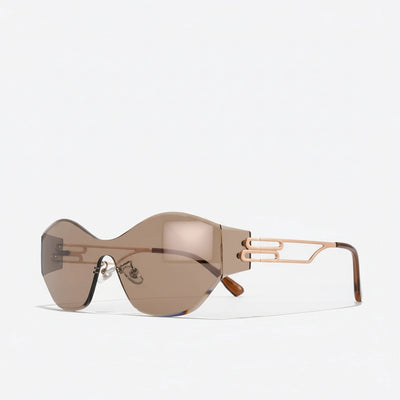
The Sniper: Bronze & Copper (The Best)
- Effect: Blocks 70-90% of Blue Light.
- Result: Maximum contrast and haze reduction.
- Top Pick: Vanguard Bronze.
-
The Volume Knob: Grey & Green (The Good)
- Effect: Reduces all colors equally.
- Result: True color perception, but less "pop" in hazy conditions.
- Top Pick: Midnight Black.
-
The Amplifier: Blue Tints (The Bad)
- Effect: Transmits Blue Light.
- Result: Looks cool aesthetically, but offers zero HEV protection (unless it has a specific backend coating). Avoid these if your goal is contrast.
Conclusion: Clarity is a Filter
We often think "clarity" means a transparent lens.
But in the real world of scattered sunlight, clarity is a filter.
By removing the scattered blue wavelengths that cause haze, you allow your eyes to relax and focus on what matters.
If you drive, golf, or hike, upgrade to a High-Contrast Bronze Lens. You won't believe what you've been missing.
Sources & References
- NASA: Why is the Sky Blue? (Rayleigh Scattering) — The physics of atmospheric light scattering.
- Review of Optometry: The Lowdown on Blue Light — Clinical analysis of HEV risks.
- American Macular Degeneration Foundation: UV and Blue Light Risk Factors — Health implications of long-term exposure.