Why Your Eyes Hurt in Bright Light: The Science of Photophobia & Rose Tints

You are sitting in an office with fluorescent lights, and you feel a throbbing pain behind your eyes.
You step outside on a cloudy day, and you have to squint immediately.
You aren't trying to be difficult. You are likely suffering from Photophobia.
For millions of people prone to migraines or sensory processing sensitivity, light isn't just visual information—it is a pain trigger.
Most people think the solution is to wear the darkest sunglasses possible. Neurobiologists disagree.
Darkness can actually make your eyes more sensitive over time. The medical solution lies in specific wavelengths, particularly Rose and Pink tints.
Here is the science of why light hurts, and how to manage it without living in the dark.
The Diagnosis: Are You "Photophobic"?
Photophobia is not a fear of light; it is a hypersensitivity to it. It is a neurological condition where the connection between the eye and the brain interprets brightness as pain.

The Biology: ipRGCs (The Cells That Feel Pain)
Your eye has rods (for low light) and cones (for color). But researchers have discovered a third type of cell: Intrinsically Photosensitive Retinal Ganglion Cells (ipRGCs).
- Function: These cells do not help you "see" images. They sense light intensity to regulate your sleep cycle.
- The Pain Link: Unlike rods and cones, ipRGCs connect directly to the Trigeminal Nerve (the pain center of the head/face).
- The Trigger: According to research published in Nature Neuroscience, these cells are most reactive to Blue Light (480nm).
Data Table: Symptoms of Light Sensitivity
| Symptom Stage | Typical Experience | Likely Trigger |
| Mild Sensitivity | Squinting on cloudy days; needing sunglasses immediately upon exiting doors. | Glare / UV Scattering |
| Digital Eye Strain | Dry, "gritty" eyes or throbbing temples after 2 hours of screen use. | HEV Blue Light (Screens) |
| Clinical Photophobia | Physical pain (headache/nausea) from fluorescent lights or standard daylight. | ipRGC Over-stimulation |
| Migraine Aura | Visual disturbances (zig-zags) followed by severe headache. | Neurological Trigger |
The "Vampire Effect": Why Darker Lenses Are NOT the Answer
If light hurts, your instinct is to block it all out with pitch-black lenses (Category 4).
This is a mistake.
Understanding "Dark Adaptation"

If you wear dark sunglasses indoors, your eyes adapt to the darkness. Your pupils dilate (widen) to capture every photon.
- The Result: When you eventually take the glasses off, normal light levels feel blindingly painful. This is called Chronification of sensitivity. You are training your eyes to be vampires.
The Goal: Filter, Don't Block
The objective is not to live in a cave; it is to filter out the specific "Pain Wavelengths" (Blue/Green 480nm) while letting the "Safe Wavelengths" (Red/Orange) pass through.
The Medical Solution: Rose & Pink Tints
In the 1990s, researchers at the University of Birmingham (UK) and later University of Utah developed a specific tint called FL-41 (a rose-colored filter) to treat migraines.
Why Rose Works
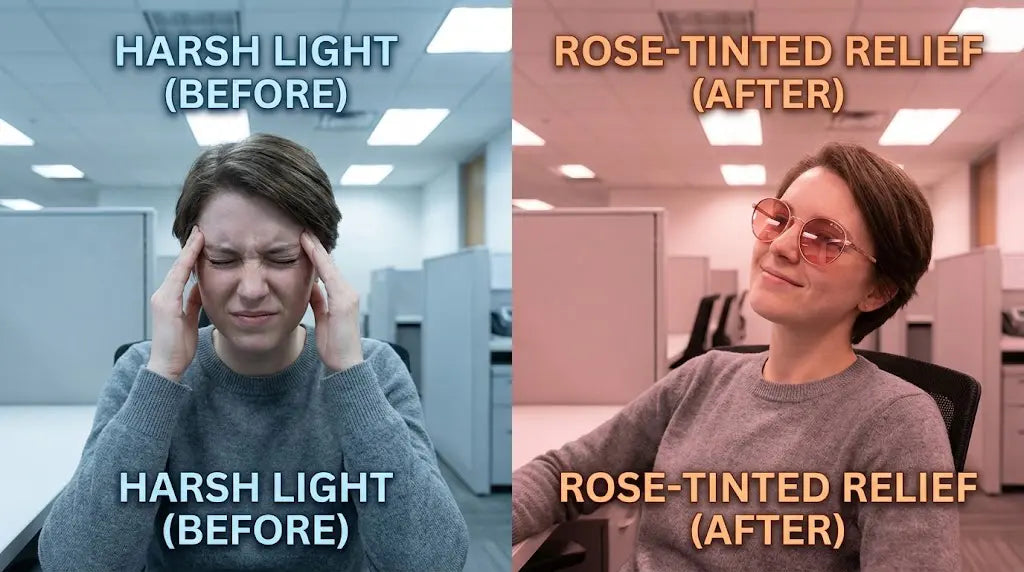
Rose and Pink tints specifically target the 480nm–520nm spectrum—the exact frequency that aggravates the ipRGCs.
By blocking this "pain spike" while allowing other colors through, these lenses relax the brain without causing Dark Adaptation.
Data Table: Lens Color Efficacy for Photophobia
| Lens Tint | Blue Light Block % | Indoor Usability | Migraine Relief Potential |
| Grey / Black | High (Overall reduction) | Poor (Too dark, causes adaptation) | Low (Outdoors only) |
| Blue | Zero (Transmits blue) | Fair | Negative (Can worsen pain) |
| Yellow | Medium (Blocks blue) | Good | Moderate |
| Rose / Pink | High (Targeted 480nm block) | Excellent | Highest (Medical Standard) |

BAPORSSA Recommendation
For indoor use or overcast days, our Y2K Gradient Pink Series offers a functional alternative to clinical eyewear. The pink tint softens the harsh blue spikes of fluorescent lighting and screens, providing a "visual cushion" for sensitive nerves.
Indoor vs. Outdoor Protocols
Managing photophobia requires a "Quiver" strategy. You need different tools for different environments.
1. The "Bunker" Strategy (Outdoors / High Glare)
When sunlight is intense, you need to block Glare (reflected light) which is a massive trigger for the Trigeminal Nerve.
- Tool: Vanguard Bronze (Polarized).
- Why: Polarization stops the "spike" of glare. The Bronze tint filters blue light. The Wrap shape blocks side-light leakage.
2. The "Filter" Strategy (Indoors / Screen / Overcast)
When the light is ambient (fluorescent office, cloudy day), you need to block Blue Light without darkening the room.
- Tool: Y2K Rose or Gradient Tints.
- Why: Allows for social eye contact and safe indoor navigation while dampening the painful frequencies.

Data Table: The Photophobic Daily Routine
| Environment | Light Source | Recommended Lens Type | BAPORSSA Pick |
| Office / Home | LED / Fluorescent | Light Rose / Pink (Cat 1) | Y2K Gradient Pink |
| Driving (Cloudy) | Diffused White Light | Copper / Rose (Cat 2) | Classic Gradient |
| Beach / Snow | Reflected Glare | Polarized Mirror (Cat 3) | Spectra X Mirror |
| Night Driving | Headlights | Clear AR (No Tint) | (Use Prescription) |
Frame Geometry: The "Side-Light" Trigger
Lens color is only 50% of the solution.
Research on the Peripheral Light Focusing Effect shows that light entering from the side (peripheral vision) can be even more irritating than light from the front because it hits the retina at an unchecked angle.
- The Mistake: Wearing small, flat round glasses. Light leaks in from the top and sides.
- The Fix: Wearing Wrap-Around Shields. These create a "Dark Room" effect for your eyes, blocking peripheral triggers completely.
Conclusion: Don't Hide in the Dark
If you suffer from migraines or light sensitivity, your instinct is to retreat. But you cannot live your life in a dark room.
Science offers a better way: Selective Filtering.
By using Rose/Pink tints indoors to calm your ipRGCs, and Polarized Wraps outdoors to kill glare, you can reclaim your visual comfort.

Stop squinting. Explore our Relief & Comfort Collection.
Sources & References (10 Authoritative Citations)
- Harvard Health Publishing: Light sensitivity (photophobia): Symptoms, causes, and treatment — General medical overview.
- American Migraine Foundation: Photophobia and Migraine — The link between headaches and light.
- Nature Neuroscience: Melanopsin-expressing retinal ganglion-cell photoreceptors — The discovery of ipRGCs and their role in pain.
- Journal of Neuro-Ophthalmology: Photophobia: looking for causes and solutions — Clinical analysis of light pain.
- University of Utah Health: FL-41 Tint for Migraines — The original research on rose tints.
- National Headache Foundation: Light Sensitivity — Lifestyle management for migraineurs.
- Brain (Oxford Academic): A neural mechanism for exacerbation of headache by light — Neurobiology study.
- The Migraine Trust: Glasses for migraine — Efficacy of colored filters.
- American Academy of Ophthalmology: What is Photophobia? — Definitive symptoms list.
- Review of Optometry: Tinting for Relief — Optician guidelines for tint selection.
BAPORSSA Editor's Selection

The Amber Titanium
Ultra-lightweight 16g aerospace titanium meets high-clarity optics. Designed for the minimalist luxury aesthetic.
SHOP THE SELECTION