








You bought a pair of sunglasses labeled "Polarized." They look great, but how do you know if they are actually doing their job?
In the world of eyewear, "Polarized" is more than just a buzzword. It is the difference between squinting through harsh glare and seeing the world in high-definition comfort. Whether you are driving into the sunset or looking out at the ocean, true polarization is a safety essential.
Not sure what polarization actually does? For a deep dive into the physics of light waves and how our lens technology works, read our Detailed Explanation of Polarized Sunglasses Page.
Here are three simple ways to test if your sunglasses are the real deal—no fancy equipment required.
Method 1: The Digital Screen Test (Easiest)
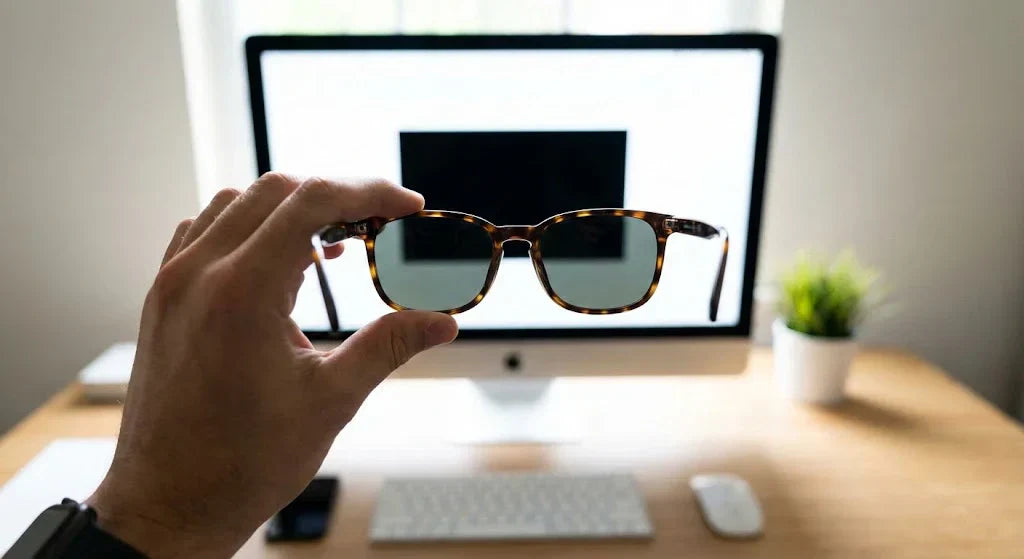
You are likely reading this on a device that emits polarized light. You can use your smartphone, tablet, or computer monitor to test your eyewear instantly.

-
Turn up the brightness on your screen and open a white background (like a blank Google doc).
-
Hold your sunglasses in front of the screen.
-
Rotate the sunglasses 60 to 90 degrees.
The Verdict:
-
If it’s Polarized: The lenses will turn significantly darker or completely black as you rotate them. This happens because the polarized filter aligns with and then blocks the polarized light from the screen.
-
If it’s Non-Polarized: The tint will remain the same, no matter how much you rotate them.
Method 2: The Two-Pair Test
If you have another pair of sunglasses that you know are polarized (or a friend’s pair), you can use physics to verify your new ones.
-
Hold one pair horizontally.
-
Hold the second pair vertically (at a 90-degree angle) directly behind the first pair.
-
Look through the overlapping lenses.
The Verdict:
If both pairs are polarized, the overlapping area should go nearly pitch black, blocking out all light. This is called the "Cross-Polarization" effect.
Method 3: The Glare Test (The Real World Scenario)

The true test, of course, is how they perform in reality. Find a reflective surface—a car windshield, a shiny floor, or a body of water.
Without the glasses, you will see a harsh white reflection (glare) bouncing off the surface. Put your BAPORSSA sunglasses on.
The Verdict:
If the harsh white reflection suddenly vanishes, revealing what is underneath (like the interior of the car or the fish in the water), congratulations—you have high-quality polarized lenses.
Why BAPORSSA Takes Polarization Seriously
At BAPORSSA, we don't just dip our lenses in dye. We use a 9-layer filtration technology that physically embeds the polarizing core within the lens. This ensures the filter never peels or fades over time.
We believe that style means nothing without clarity. That’s why our Polarized Performance Collection is tested rigorously to eliminate 99.9% of glare, ensuring you drive safer and see clearer.
Ready to see the difference?
[Shop Our Polarized Collection ->]