
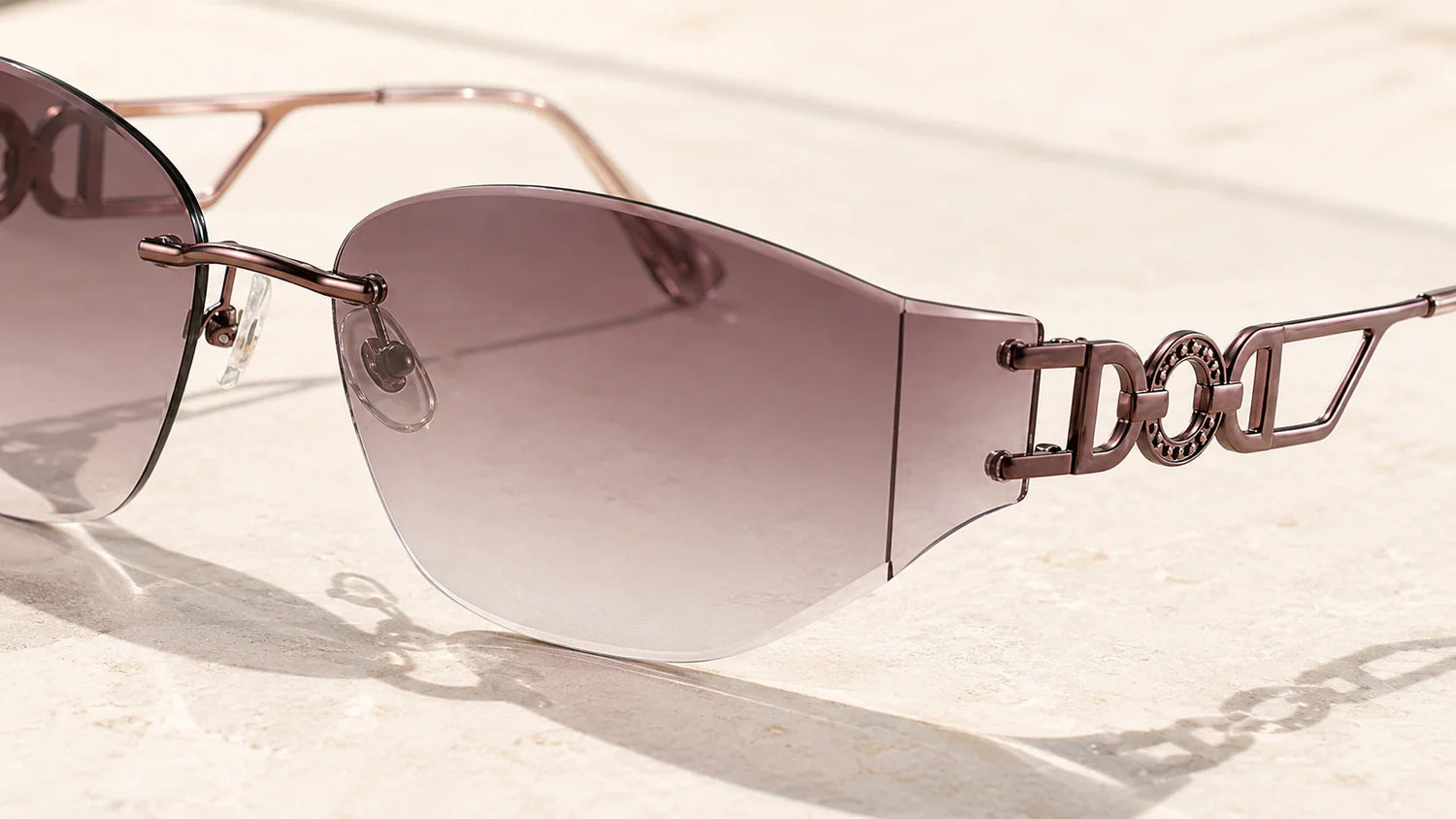
Rimless sunglasses are not automatically fragile. They can be durable enough for daily wear when the exposed lens edges, bridge hardware, screw points, temples, and nose pads are built and balanced correctly.
The important difference is simple: a full-rim frame protects the lens edge with a visible border, while a rimless frame depends more on precise connection points. That is why rimless durability should be judged by weak points, not by frame thickness alone.
This guide is a buying checklist. It is not a general rimless style guide. For the broader style route, use the Rimless Sunglasses Guide. For the difference between frame types, use the Rimless vs Full-Frame Guide.
Quick Answer: Are Rimless Sunglasses Fragile?
No. Rimless sunglasses are not fragile by default. They become fragile when the lens edge is poorly finished, the bridge pulls unevenly, the screw points loosen, the temples twist the front, or the wearer stores them without a case.
A good rimless pair should feel stable in three places:
- At the lens edge: no rough cuts, sharp edges, or uneven drilling.
- At the hardware: no rattling, wobble, or crooked bridge pressure.
- On the face: no sliding, temple squeeze, or constant adjustment.
If those points feel controlled, rimless sunglasses can deliver a lighter, cleaner face look without feeling disposable.

Rimless Durability Checklist
| Weak Point | What to Check Before Buying | Warning Sign |
|---|---|---|
| Lens edge | Smooth, polished, even edge with no rough finish | Sharp-feeling edge, uneven cut, visible stress marks |
| Bridge | Centered bridge that holds both lenses level | One lens sits higher, bridge twists, front feels crooked |
| Screws or pins | Hardware feels tight, quiet, and aligned | Rattling, wobble, visible looseness |
| Temples | Temples open smoothly and sit evenly | One temple pulls harder, hinge feels floppy or forced |
| Nose pads | Pads support the frame without sharp pressure | Sliding, red marks, uneven height, cheek contact |
| Storage | Pair comes with or fits safely in a protective case | Loose bag storage, pressure from keys, laptop, or luggage |
1. Lens Edge: The First Place to Check
In full-frame sunglasses, the frame wraps around the lens edge. In rimless sunglasses, that edge is exposed, so the finish matters more.
Look for a clean, smooth edge. The lens should not feel rough or sharp. Uneven finishing can create weak spots because pressure is concentrated at the places where the lens connects to hardware.
The lens material also matters, but the edge finish is what you can actually inspect. A well-made rimless pair should look intentional from the front and from the side.
2. Bridge Hardware: The Part That Keeps Both Lenses Balanced
The bridge is one of the most important durability points on rimless sunglasses. It keeps the two lenses aligned and controls how pressure moves across the front of the frame.
Before buying, check whether the bridge sits flat and centered. If one lens looks slightly higher, or if the bridge appears to pull one side harder than the other, the pair may feel unstable over time.
A durable rimless frame should not feel like two separate lenses connected by fragile hardware. It should feel like one balanced object.
3. Screws, Pins, and Mounting Points
Small hardware decides how rimless sunglasses age. A pair can look refined when new, but if the screw points loosen quickly, the fit and front alignment will start to fail.
Open and close the temples slowly. The movement should feel smooth and controlled. Hold the pair lightly at the bridge and check whether the lenses stay aligned. Avoid any pair that rattles, clicks loosely, or twists with very little pressure.
Do not overtighten hardware by hand unless you know what you are doing. Too much pressure at a rimless mounting point can be worse than a slightly loose screw.
4. Temple Tension: Stable Without Squeezing
Temple tension affects both comfort and durability. If the temples clamp too hard, they can pull against the front of the frame. If they are too loose, the sunglasses may slide and create repeated adjustment stress.
The ideal feel is controlled, not tight. The temples should open smoothly, sit evenly, and hold the pair without pressing hard into the side of the head.
This is especially important for daily wear, travel, headphones, hats, and long hair. A rimless pair should feel light without feeling unstable.

5. Nose Pads: Small Part, Big Durability Impact
Nose pads are not just a comfort detail. They control how the frame balances on the face. If the pads sit badly, the wearer keeps adjusting the sunglasses, and repeated adjustment adds stress to the front.
Good nose pads should support the pair without sharp pressure. They should help the lenses sit at a stable height, not slide down or tilt into the cheeks.
If your main problem is sliding, the better next read is How to Stop Glasses From Sliding Down. Keep that topic separate from this durability checklist.

Rimless vs Full-Rim Durability
| Type | Durability Logic | Main Risk |
|---|---|---|
| Rimless | Relies on clean lens edges, bridge balance, and precise hardware | Stress at exposed lens and mounting points |
| Full-rim | Uses a frame border to hold and protect the lens edge | More visual weight, heavier frame feel, hinge pressure |
| Semi-rimless | Combines partial lens support with a lighter open look | Mixed pressure between framed and exposed areas |
Full-rim sunglasses are not automatically better. Rimless sunglasses are not automatically weaker. They simply place structural responsibility in different places.
How to Make Rimless Sunglasses Last Longer
- Use both hands when putting them on or taking them off.
- Store them in a case before placing them in a bag, backpack, or suitcase.
- Do not leave them loose under keys, laptops, books, or luggage.
- Rinse dust or sand before wiping the lens surface.
- Use a microfiber cloth instead of shirts, paper towels, or rough fabric.
- Clean nose pads before makeup, sunscreen, or oil buildup hardens.
- Avoid twisting the temples to force a fit correction.
- Do not leave them under long, direct heat inside a car when possible.
Most rimless damage happens off the face: inside bags, cars, luggage, or during rough cleaning. The simplest protection is consistent storage.
When Rimless Sunglasses May Not Be the Right Choice
Choose a full-rim frame instead if you often throw sunglasses into a bag without a case, prefer a heavy frame border, or need eyewear for high-impact sport use.
Choose rimless if you want less visual bulk, a lighter face result, and a pair that feels cleaner for daily movement, driving, travel, and bright outdoor light.
BAPORSSA Rimless Build Checklist
For BAPORSSA, rimless design is not about removing structure completely. It is about removing unnecessary visual weight while keeping the details that support real use.
- Clean lens edge finish for a refined, exposed-lens look.
- Stable bridge structure to keep the front balanced.
- Controlled temple movement for daily wear.
- Comfort-focused nose pads to reduce sliding and repeated adjustment.
- Polarized UV400 lenses for glare control and outdoor clarity.
- Lightweight construction for a cleaner face look.
Rimless sunglasses are not unbreakable. No eyewear is. The better standard is whether the pair handles pressure intelligently: at the edge, at the bridge, at the temples, and on the face.
Recommended Rimless Styles
Start with the styles below if you want a rimless look with stronger daily-wear purpose:



FAQ
Do rimless sunglasses break easily?
Not automatically. They are more dependent on lens edge finish, bridge hardware, screw points, temple balance, and careful storage than full-rim sunglasses.
What is the weakest point on rimless sunglasses?
The main weak points are the lens mounting areas, bridge, screws or pins, temples, and nose pads. These are the first places to check before buying.
Are rimless sunglasses weaker than full-rim sunglasses?
They are different, not simply weaker. Full-rim frames protect the lens edge with a border. Rimless frames rely more on precise hardware and balanced pressure points.
Can rimless sunglasses be worn every day?
Yes, if they fit well and are stored properly. Use a case, avoid twisting the temples, and clean the lenses and nose pads gently.
How should I store rimless sunglasses?
Store them in a protective case whenever they are not on your face, especially in bags, luggage, cars, or crowded desk spaces.