

Mirror Lenses vs. Polarized: Are Flash Coatings Just for Looks?
You see them on professional skiers, beach volleyball players, and high-stakes poker pros.
Mirror Lenses (also known as Flash Coatings) are the ultimate style statement. They look cool, futuristic, and impenetrable.
But are they actually doing anything for your eyes? Or is it just shiny paint?
Many buyers assume "Mirror" is just another word for "Polarized." It isn't.
From a physics perspective, mirror lenses function completely differently from standard tints. They are the only lenses that can physically lower the temperature around your eyes.
Here is the science behind the "Poker Face."
Absorption vs. Reflection: How Mirrors Handle Light
To understand why mirror lenses are special, we have to look at Thermodynamics.
Standard Tint: "Absorbing" Light (The Sponge)
A standard black or grey lens works by Absorption. The dye in the lens soaks up light photons to stop them from hitting your eye.
- The Physics: When energy is absorbed, it doesn't disappear; it transforms. In this case, light energy turns into Heat Energy.
- The Result: On a scorching day, a very dark black lens can actually get warm, radiating that heat toward your eye socket.
Mirror Coating: "Bouncing" Light (The Shield)
A mirror lens works by Reflection. It creates a "boomerang effect."
- The Physics: A microscopic layer of metal oxides (Titanium, Chromium, or Zirconium) on the surface bounces 10–60% of the light away before it even touches the lens material.
- The Thermal Benefit: Because the light is reflected, not absorbed, it doesn't convert to heat. This keeps the "optical climate" behind your glasses significantly cooler.
The Big Confusion: Mirror vs. Polarized
This is the #1 question we get: "Are these polarized?"
The answer is: They are two different technologies that can work together.
1. Mirror = Brightness Reduction
Think of a Mirror coating like a Dimmer Switch.
It reduces the overall intensity of light entering the eye. It is indiscriminate—it blocks sunlight, ambient light, and glare equally.
2. Polarized = Glare Filtration
Think of Polarization as a Venetian Blind.
It blocks light based on angle. It specifically targets the horizontal glare bouncing off wet roads or water. (Read more in our Polarized Guide).
The Ultimate Combo: The "Double-Layer"
For maximum protection, brands like BAPORSSA combine both. We put a polarized filter inside the lens to kill glare, and a mirror coating outside to reflect heat.
Result: You get the visual clarity of polarization with the thermal comfort of a mirror.
The "Poker Face" Factor: Privacy & Psychology
Beyond physics, there is psychology.
100% Privacy
Standard dark lenses are usually translucent—people can still see the outline of your eyes in bright sun.
Full Mirror lenses are opaque. The observer sees only their own reflection.
- Why Security Use Them: It hides the wearer's gaze direction. You can scan a crowd without anyone knowing where you are looking.
- Why You Use Them: It provides a psychological barrier—a "mask" of confidence.
Aesthetics: The "Pop" Factor
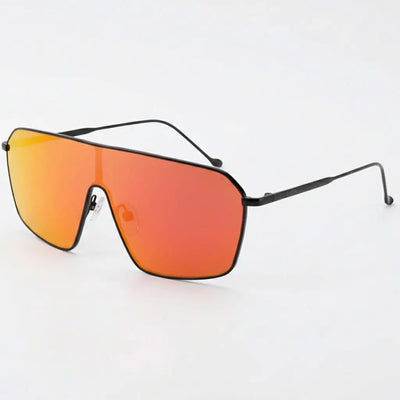
Mirrors allow you to add vibrant colors (Gold, Blue, Silver) to your look without tinting your vision red or blue. You can have a bright Vanguard Pink mirror that looks grey/neutral from the inside.
The Trade-Off: Durability and Care
We believe in radical honesty. Mirror lenses have one major weakness: They show scratches.
The "White Scratch" Problem
On a standard grey lens, a scratch is just a groove in grey plastic. You barely see it.
On a mirror lens, the reflective metal layer is on the surface. If you scratch it, you remove the metal, revealing the lens underneath.
This creates a high-contrast "bright streak" where light passes through the scratch. It is impossible to ignore.
Cleaning Protocol: The "Rinse First" Rule
Because the coating is delicate, you must change how you clean them.
- NEVER dry wipe. Dust on the lens acts like sandpaper. Wiping a dry mirror lens is a guarantee of micro-scratches.
- Rinse with water. Flush away the dust particles first.
- Dab, don't scrub. Use a clean microfiber cloth to gently absorb the water droplets.
(See our full Cleaning Guide).
When to Choose Mirror Lenses
Mirrors aren't just for looking cool. They are functional tools for specific environments.
-
High Altitude (Snow & Mountains):
Snow reflects 80% of UV rays. On a mountain, you are hit by "two suns" (one from the sky, one from the ground). A mirror coating is essential to handle this double-intensity light. -
Open Ocean:
Similar to snow, water creates a massive reflector. A mirror coating reduces the raw brightness that causes eye fatigue. -
Photophobia (Light Sensitivity):
If you have sensitive eyes that water easily in sunlight, the extra 10–60% light reduction of a mirror lens is a medical relief.
BAPORSSA Mirror Collection Highlights
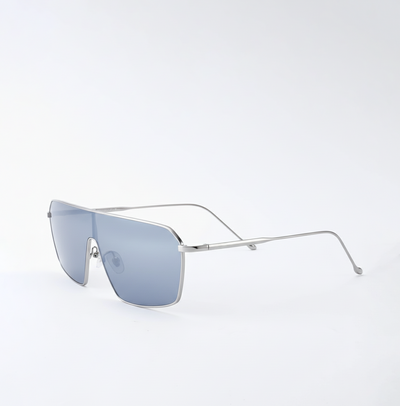
- The High-Tech Shield: Spectra X Series. Features a subtle flash coating for heat rejection without being overly aggressive.
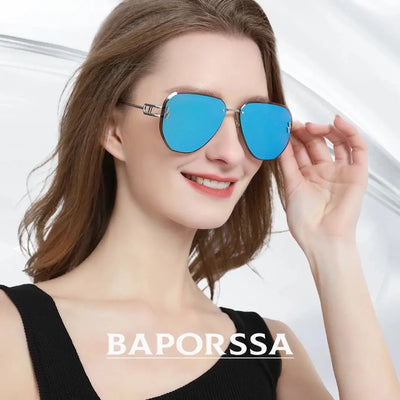
- The Classic Cool: Retro Double-Layer Mirror. Combines vintage aesthetics with modern polarized + mirror performance.
Conclusion: High Performance Requires High Care
Mirror lenses are like a high-performance sports car. They offer superior heat rejection and unmatched style, but they require a gentle touch.
If you are willing to follow the "Rinse First" rule, the comfort of a cool, shaded view is worth every second of maintenance.
Reflect the heat. Keep your cool.
Sources & References
- Explain That Stuff: The Physics of Mirrors and Reflection — Understanding light bounce.
- All About Vision: Mirror Coatings Explained — Industry overview of flash coatings.
- Scientific American: Why Do Dark Objects Get Hotter? — The thermodynamics of absorption vs. reflection.