
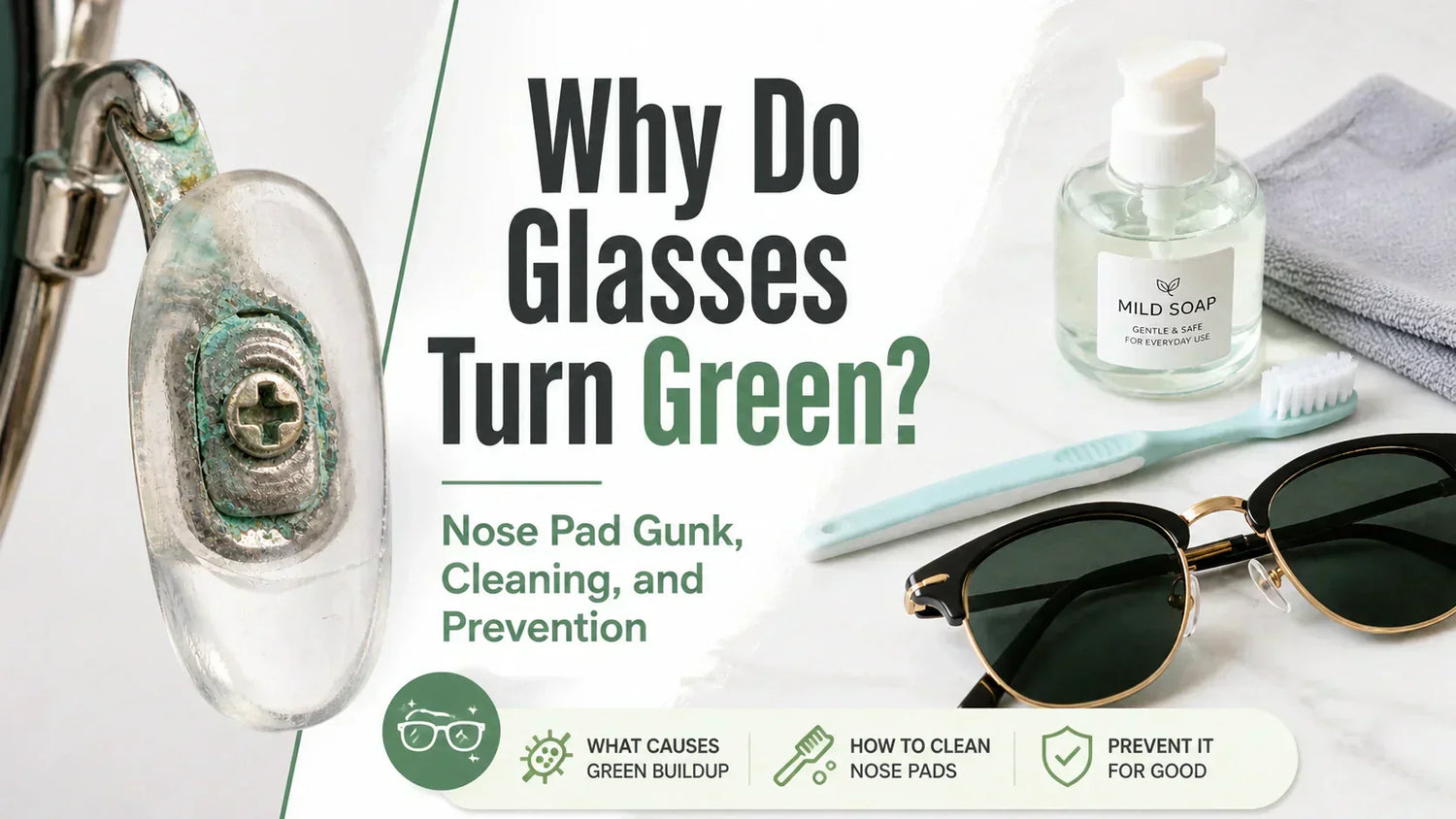
Quick answer: the green stuff on glasses nose pads is usually not mold. Most of the time, green gunk on glasses is a mix of sweat, skin oil, sunscreen, makeup, moisture, old nose pad residue, and a metal reaction around the bridge, screws, or nose pad arms.
If the green stuff wipes off and stays gone, it is mostly a cleaning and nose-pad maintenance issue. If it comes back within days, stains your skin, or appears around tiny metal arms and screws, the frame may have a worn finish or exposed metal contact point that keeps reacting with moisture and sweat.
| Question | Short answer |
|---|---|
| What is the green stuff on glasses? | Usually sweat, oil, dirt, old nose-pad residue, and metal reaction around the bridge or nose-pad hardware. |
| Is green gunk on glasses dangerous? | Usually not an emergency, but it can irritate skin and should not sit against your nose every day. |
| How do you clean it? | Use lukewarm water, mild dish soap, a microfiber cloth, and a soft brush only around hardware gaps. |
| Why does it come back? | Old pads, trapped moisture, worn finish, exposed metal, sunscreen, sweat, or heavy pressure at the nose bridge. |
| When should you replace the frame? | If green residue returns within days, hardware looks rough, or the same contact point irritates your skin repeatedly. |

Quick Route: If Green Nose Pad Gunk Keeps Coming Back
No sunglasses or glasses frame should be described as magically immune to sweat, oil, sunscreen, or dirt. The better buying question is simpler: which frame route gives you cleaner contact points, less pressure, and easier maintenance?
| If your problem is... | BAPORSSA route | Verified reason |
|---|---|---|
| Dirty or uncomfortable nose pads | Luma | Adjustable nose pads, spring-hinge comfort, 25g weight, Aluminum-Magnesium frame, Nylon lens, Cat. 3 VLT route. |
| You want the strongest verified material route | Onyx | Product specs list Beta Titanium, adjustable nose pads, 20g weight, Nylon polarized lens, Cat. 3 VLT, and 95 reviews. |
| Heavy frame pressure on the nose | Air | Rimless daily build, Premium Nylon product parameter, adjustable fit, 28g size metafield, and the strongest recent checkout/purchase signal in this group. |
| You want a cleaner rimless face line | Backbone | Product specs list High-Nickel Cupronickel, Nylon lens, adjustable nose pads, 22g weight, and the strongest recent product-interest signal. |




What Is the Green Stuff on Glasses Nose Pads?
The green stuff on glasses nose pads is usually a residue problem plus a material-contact problem. The residue part comes from daily wear: sweat salts, skin oil, sunscreen, makeup, dust, and moisture. The material-contact part appears when that mixture sits around metal hardware, screws, nose-pad arms, or a worn finish.
That is why the green often appears around the nose bridge first. This area is warm, damp, and pressed against the skin. It also has small gaps where residue can sit after cleaning.
- Green film on the clear pad: usually old pad residue, sweat, oil, and sunscreen.
- Green around metal arms or screws: possible metal reaction or worn finish.
- Green mark on your skin: residue is transferring from the frame to your nose.
- Green that returns quickly: cleaning may be removing the symptom, not the contact-point problem.
Why Do Glasses Turn Green?
Glasses turn green when moisture, sweat, oil, and exposed or aging metal meet repeatedly. The same thing can happen to prescription glasses and sunglasses, especially in hot weather or after sunscreen-heavy outdoor wear.
On many frames, the surface finish is not the whole material. If the finish wears down around the nose pad arm, bridge, or screw, sweat and moisture may reach the metal underneath. That reaction can leave a green or blue-green residue.

- Sweat adds salt and moisture.
- Skin oil makes residue sticky.
- Sunscreen and makeup collect around pads and bridge hardware.
- Air and humidity support oxidation around exposed metal.
- Pressure at the nose bridge keeps the area warm and damp.
Is Green Gunk on Glasses Dangerous?
For most people, green gunk on glasses is more of a hygiene and skin-irritation issue than an emergency. It still should not sit against your skin every day.
The nose bridge is a high-contact area. If old residue, corroded hardware, sweat, dirty pads, and sunscreen sit there for hours, your skin may become red, itchy, sore, or irritated. If the skin becomes cracked, painful, or repeatedly irritated, stop wearing the frame until it is cleaned and reassessed.
| What you see | Likely meaning | Next step |
|---|---|---|
| Light green film that cleans off | Mostly residue from daily wear | Clean and dry more regularly. |
| Green around screws or metal arms | Possible exposed metal or worn finish | Clean carefully; expect it may return. |
| Green on your nose after wearing | Residue is transferring to skin | Stop wearing until cleaned; replace pads if needed. |
| Red, itchy, sore, or cracked skin | Skin irritation at the contact point | Stop wearing and reassess; persistent irritation may need professional advice. |
| Green returns within days | Frame-quality or hardware-contact warning | Cleaning is now maintenance, not a full fix. |
Quick Test: Dirt, Old Nose Pads, or Exposed Metal?
Before blaming the whole frame, look closely at where the green sits.
| Where the green appears | Most likely cause | Best next step |
|---|---|---|
| Only on the clear nose pad | Old pad, sweat, oil, sunscreen, makeup | Clean it; replace the pad if it stays yellow, cloudy, sticky, cracked, or smelly. |
| Around the tiny metal arm | Hardware corrosion or worn finish | Clean carefully, but expect it to return if metal is exposed. |
| Around the screw area | Trapped moisture and residue | Use a soft brush lightly or ask an optician to remove and replace pads. |
| On the bridge or frame surface | Finish breakdown or oxidizing metal | Cleaning helps temporarily; replacement may be smarter. |
| On your skin after wearing | Residue transfer from the frame | Stop wearing until cleaned; replace pads or frame if it keeps happening. |
How to Clean Green Stuff Off Glasses Nose Pads Safely
The goal is to remove green residue without scratching lenses, loosening screws, or stripping more finish from the frame. Use the mildest method first.

1. Rinse first
Run lukewarm water over the frame before rubbing. Dry-wiping can drag grit across the lens or frame surface.
2. Use mild dish soap
Use a small drop of mild dish soap with your fingers. Work around the nose pads, bridge, hinges, and screws. Avoid harsh household cleaners.
3. Use a soft brush only where needed
If buildup is stuck around the nose pad arm or screw, use a very soft toothbrush or cotton swab with light pressure. Focus on the hardware gap, not the lens surface.
4. Rinse and dry completely
Rinse away soap, then dry with a clean microfiber cloth. Pay special attention to pad arms, screws, and the bridge. Moisture left in small gaps gives green residue a head start.
5. Replace old nose pads
If the clear pads are yellow, cloudy, sticky, hard, cracked, or still smell dirty after cleaning, replace them. Nose pads are small, but they control how clean the frame feels on your face.
What Not to Use on Green Nose Pad Gunk
Do not turn a small green residue problem into a scratched-lens or damaged-finish problem.
| Avoid | Why |
|---|---|
| Bleach | Too harsh for eyewear finishes and skin-contact parts. |
| Vinegar soak | May attack certain coatings, plating, or small hardware. |
| Baking soda scrub | Can be abrasive enough to scratch surfaces. |
| Toothpaste | Often abrasive and not made for lens coatings. |
| Hot water | Can stress coatings or distort some parts. |
| Dry paper towel | Can drag grit and scratch lenses. |
If the green is deep inside a screw mount or under the pad arm, let an optician remove the pads and clean or replace the small parts. Force is how frames get damaged.
Why the Green Stuff Comes Back After Cleaning
If green residue returns quickly, the problem is probably not your cleaning technique. It is usually one of these:
- The nose pads are old and holding oil.
- The screw area traps moisture after every wear.
- The surface finish has worn down near the pad arm.
- Sweat and sunscreen keep reaching exposed metal.
- The frame presses too hard, keeping the pad area warm and wet.
- The frame is being stored damp in a bag, bathroom, or hot car.
This is where the article becomes a frame-quality check. A frame that needs constant cleanup around the bridge is not aging cleanly at the contact point.

When to Replace Nose Pads vs the Whole Frame
| Situation | Best choice | Reason |
|---|---|---|
| Green appears after months of wear and cleans off | Clean and monitor | Normal buildup can happen around high-contact parts. |
| Nose pads are yellow, sticky, cloudy, cracked, or smelly | Replace nose pads | The pad material may be holding oil and residue. |
| Green returns within days | Consider replacing the frame | Exposed metal or worn finish may still be reacting. |
| Skin gets irritated every time | Stop wearing and reassess | The contact point may not suit your skin. |
| Hardware looks pitted, rough, or discolored | Replace rather than polish forever | The frame is no longer easy to keep clean. |
What to Look for in Cleaner-Feeling Frames
If your old glasses keep turning green, the better question is not only “How do I clean this?” The better question is “What should I avoid next time?”
- Adjustable, replaceable nose pads so the contact point can be cleaned or changed.
- Lighter frame weight so the pads do not press as hard into the skin.
- Clean bridge hardware with fewer grime traps.
- Better-verified material routes around high-contact areas.
- Rimless or lighter visual builds if heavy frames make the nose area feel crowded.
For a deeper material route, read the BAPORSSA sunglasses material guide. For the lighter rimless route, read the rimless sunglasses guide.
Where Titanium Fits in This Problem
Titanium can be a cleaner material route when the product specifications actually confirm titanium. It should not be described as a magic anti-green solution, because sweat, sunscreen, skin oil, and moisture can still collect on pads and hardware.
In this guide, Onyx is the clearest titanium route because its product specs list Beta Titanium, adjustable nose pads, 20g weight, Nylon polarized lenses, Cat. 3 VLT, and 95 reviews. Shift also has Beta Titanium product specs, but this article prioritizes Onyx because it has stronger review proof and a closer fit to the frame-quality discussion.
BAPORSSA Route: Cleaner Contact Points, Less Pressure, Easier Maintenance
This route is based on live product specs, nose-pad metadata, frame material metadata, weight, review proof, inventory, and recent product behavior. It does not claim that any product will stop residue forever. It simply gives a cleaner, more maintainable starting point when old frames keep creating green buildup.
| Product | Best for | Verified product basis |
|---|---|---|
| Luma | Adjustable nose-pad comfort | Adjustable nose pads, spring-hinge comfort, 25g size metafield, Aluminum-Magnesium frame, Nylon lens, Cat. 3 VLT. |
| Onyx | Verified Beta Titanium route | Beta Titanium product specs, adjustable nose pads, 20g size metafield, Nylon polarized lenses, Cat. 3 VLT, 95 reviews. |
| Air | Lighter rimless daily route | Premium Nylon product parameter, adjustable fit, Aluminum-Magnesium product specs, 28g size metafield, strong recent checkout/purchase signal. |
| Backbone | Cleanest rimless low-visual-bulk route | High-Nickel Cupronickel product specs, Nylon lens, adjustable nose pads, 22g size metafield, strongest recent product-interest and add-to-cart signal. |
How to Prevent Green Buildup From Coming Back
- Rinse sweat and sunscreen off the frame after hot days.
- Dry nose pad arms, screws, and bridge hardware completely.
- Clean pads weekly if you wear the pair daily.
- Replace cloudy, sticky, yellow, cracked, or smelly pads.
- Do not store sunglasses damp in bags, cars, or bathrooms.
- Rotate pairs if one frame is constantly wet from sweat or sunscreen.
- Check fit if the pads press hard into the bridge all day.
Prevention is not glamorous. It is just less annoying than dealing with green residue every week.
Related Craft & Fit Guides
| If your issue is... | Read this next |
|---|---|
| Frame materials and build quality | Sunglasses material guide |
| Rimless comfort and cleaner face design | Rimless sunglasses guide |
| Smudges, coating, and dirty lenses | Why are my glasses always smudged? |
| Frames sliding down your nose | How to stop glasses from sliding down |
| Frame sits low or touches cheeks | Low bridge fit sunglasses guide |
| Frame sits crooked or uneven | Why are my sunglasses crooked? |
| Choosing one better pair | BAPORSSA sunglasses buying guide |
FAQ
What is the green stuff on my glasses nose pads?
It is usually a mix of sweat, skin oil, sunscreen, dirt, old nose-pad residue, and metal reaction around the bridge or nose-pad hardware.
Is green gunk on glasses mold?
Usually, no. Green gunk on glasses is more often corrosion mixed with skin oil, sweat, and dirt. If the pads are sticky, cloudy, or old, replace them.
Is green residue on glasses dangerous?
For most people, it is more of a hygiene and skin-irritation issue than an emergency. Clean it off, avoid wearing dirty contact points, and stop wearing the frame if your skin becomes red, itchy, sore, or cracked.
How do I clean green stuff off glasses nose pads?
Rinse with lukewarm water, use mild dish soap, gently clean around the nose pads with your fingers or a soft brush, rinse again, and dry completely with a microfiber cloth.
Why do glasses nose pads turn green?
Nose pads turn green because sweat, oil, moisture, sunscreen, old pad material, and exposed metal hardware sit together in a warm high-contact area.
Why does green stuff come back after cleaning?
If the green returns quickly, the pads may be old, the screw area may trap moisture, or the metal finish around the nose pad hardware may be worn. Cleaning removes residue, but it cannot rebuild worn plating.
Should I replace nose pads or the whole frame?
Replace the nose pads if they are yellow, sticky, cloudy, cracked, or smelly. Consider replacing the frame if green residue returns quickly around the metal hardware or if the same contact point keeps irritating your skin.
What frames are better if green nose pad gunk keeps coming back?
Look for lighter frames, adjustable or replaceable nose pads, cleaner bridge hardware, and verified material specs. For BAPORSSA, Luma is the most direct adjustable nose-pad route, Onyx is the strongest verified Beta Titanium route, Air is a lighter rimless daily route, and Backbone is a clean rimless low-visual-bulk route.
Can sunglasses get green nose pad gunk too?
Yes. Sunglasses can collect sweat, sunscreen, skin oil, and moisture the same way prescription glasses do, especially in hot weather or after outdoor wear.
Can I prevent green buildup completely?
You can reduce it, but daily wear still creates sweat, oil, sunscreen, and moisture. Regular cleaning, full drying, replacing old pads, and choosing cleaner contact-point designs can make the problem much less frequent.
Final Recommendation
Green buildup is useful information. It tells you how your frame is aging where it touches your face.
Clean it once. Replace old nose pads if needed. Then watch how fast the green comes back. If the same residue returns within days, the problem is no longer just dirt. It is a sign that the frame may not be worth fighting anymore.
A better pair should feel cleaner on the face, not create another weekly chore.
Start with Luma for adjustable nose-pad comfort, choose Onyx for the verified Beta Titanium route, or try Air for a lighter rimless daily frame feel.